

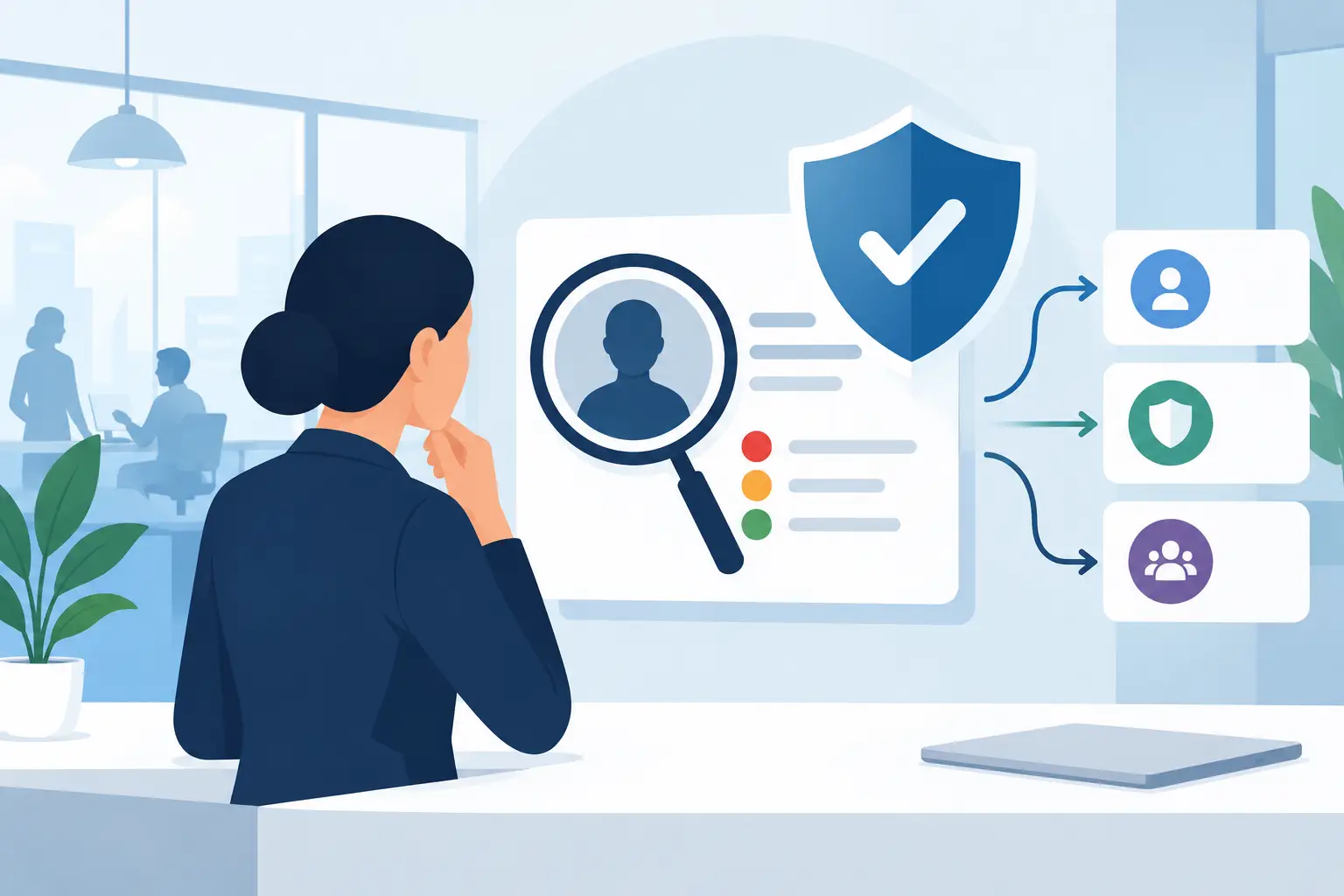
A concerning message arrives after business hours. A tenant reports that an unknown person has been watching employees enter the building. A former contractor appears on CCTV near a restricted access point. These events do not all present the same level of risk, but each requires a disciplined response. A workplace threat assessment gives security, investigations, and property operations teams a way to move from a raw report to a defensible decision without relying on instinct alone.
The goal is not to predict violence with certainty or label someone as dangerous based on a single fact. The goal is to identify concerning behaviors, understand context, reduce opportunity for harm, and escalate when the available facts justify it. Fast action matters. So does getting the facts right.
What a Workplace Threat Assessment Actually Does
A workplace threat assessment is a structured process for evaluating whether a person, behavior, communication, or situation may pose a credible risk to people, property, or operations. It is not simply a checklist, and it is not a background search conducted to satisfy curiosity. It is a case-management process that connects reporting, evidence review, protective action, documentation, and follow-up.
Effective teams separate three questions that are often mistakenly blended together: What happened? What does it mean in context? What action is proportionate right now? A hostile comment may require documentation and a welfare-focused intervention. Repeated unwanted contact combined with access attempts may warrant immediate protective measures and law enforcement coordination. The facts determine the lane.
This approach also protects against a common operational failure: treating identity as proof of intent. Knowing who appears in a CCTV frame can be relevant to an investigation, especially when access restrictions, prior incidents, or active safety concerns exist. It does not, by itself, establish dangerousness. Identification signals must be reviewed alongside behavior, timing, location, communications, and corroborating evidence.
Start With Behavior, Context, and Immediacy
The strongest assessments focus on observable conduct rather than broad assumptions about personality, appearance, or reputation. Review what the person did, said, attempted, or communicated. Then establish the surrounding context: their relationship to the site, any known grievance, their access level, the proximity to potential targets, and whether the behavior is escalating.
A report becomes more actionable when it answers practical questions. Was there a direct or implied threat? Was a specific person, place, or time mentioned? Has the individual returned after being told to leave? Did they attempt to bypass security controls? Is there evidence of stalking, fixation, surveillance, or repeated boundary violations? Has the behavior changed in frequency, intensity, or planning?
Immediacy matters. A vague complaint with no current access or contact may call for careful intake, preservation of records, and a monitored response. A person making a credible threat while approaching a worksite is a different situation entirely. If there is an immediate danger to life or safety, contact emergency services and follow your organization’s emergency procedures. Assessment should support urgent response, not delay it.
Build a Triage Process Your Team Can Repeat
Consistency is what turns a threat assessment program into an operational capability. Every report should enter through a defined intake path, whether it comes from an employee, front-desk staff member, property manager, security officer, camera operator, or online monitoring workflow.
At intake, preserve the original report in its original form. Capture dates, times, locations, involved parties, witness names, screenshots, video clips, emails, and any available incident numbers. Avoid rewriting a witness account into conclusions. Record what was observed and what was reported, then identify what still needs validation.
A practical triage model sorts cases into three working categories: routine concern, elevated concern, and urgent threat. These are internal response levels, not permanent labels placed on people. Routine concerns may need documentation and local follow-up. Elevated concerns may require access review, management notification, additional fact-finding, and a safety plan. Urgent threats call for immediate protective action, leadership notification, and potentially law enforcement engagement.
The category can change as evidence develops. That is a feature, not a weakness. Threat assessment is an ongoing process because behavior, access, and circumstances can change quickly.
Verify Before You Escalate Beyond the Facts
Speed is valuable only when it is paired with verification. Teams should confirm whether a reported subject is actually the person shown in footage, whether a message is authentic and complete, whether a claimed incident occurred at the stated time, and whether multiple reports describe the same event.
For image-based investigations, a clear CCTV frame or submitted photo can help generate a lead. Platforms such as SafetyCamAI can return confidence-scored match signals from permitted public sources, along with source references and exportable evidence for review. That signal is a starting point for human analysis, not an automated conclusion. Investigators should validate visual similarity, source context, date relevance, and the connection to the active case before taking action.
This distinction matters legally and operationally. A poor match, an outdated image, or a misread social post can send a team in the wrong direction. A human in the loop reduces that risk by requiring trained reviewers to assess the full evidence set before an escalation, site exclusion, or referral.
Match Protective Measures to the Risk
A good assessment produces an action plan, not just a case file. The right response depends on the facts, the site, and the person’s access. A commercial office, a multifamily property, a hospital, and a retail location have different exposure points and different obligations to occupants and staff.
Protective measures can be practical and temporary. A team may notify front-desk personnel, update a photo briefing for authorized security staff, review badge access, increase patrol visibility, preserve relevant camera footage, change entry procedures, or coordinate a welfare check through appropriate channels. In some cases, the best intervention is not a security measure at all. It may be an HR conversation, employee assistance referral, conflict resolution process, or clear no-contact direction.
Avoid overreacting in ways that create unnecessary harm or undermine credibility. A broad alert with an unverified identity can spread misinformation. A decision to restrict access without a documented basis can create legal and employee-relations issues. At the same time, underreacting because evidence is incomplete can leave people exposed. The standard is reasonable, proportionate action based on the information available at the time.
Documentation Is Part of the Safety Response
Threat assessment decisions may later be reviewed by leadership, HR, legal counsel, insurers, law enforcement, or a court. Your case record should show how the team reached its conclusions, what information was considered, what was not verified, and why particular actions were selected.
Keep a clear timeline. Distinguish firsthand observations from secondhand reports. Preserve source material where permitted. Record who reviewed footage or match signals, who approved each action, which stakeholders were notified, and when the next review is scheduled. If an assessment determines that no immediate threat exists, document that reasoning as carefully as you would document an escalation.
Evidence packaging should make handoff easier, not create more work. A concise incident file with original materials, review notes, source context, confidence considerations, and an action log helps the next decision-maker understand the case without reconstructing it from messages and disconnected folders.
Keep Compliance Inside the Workflow
Threat assessment work involves sensitive information, which makes guardrails essential. Limit access to personnel with a legitimate business need. Use information only for lawful, safety-related purposes. Follow organizational policies, applicable privacy requirements, retention schedules, labor obligations, and any rules governing surveillance or biometric data in your jurisdiction.
Be especially careful when using public-source intelligence or facial matching tools. Public availability does not erase the need for a legitimate purpose, human review, and careful handling. These tools should support investigation and verification in a public-interest lane, not consumer screening, harassment, or decisions that exceed the evidence.
Your process should also make room for correction. If new facts undermine an earlier assumption, update the assessment, revise the briefing, and limit further distribution of inaccurate information. Discipline builds trust inside the organization and makes teams more effective when a serious case emerges.
A workplace threat assessment works best when it becomes a practiced habit: preserve the facts, verify the signal, assess the behavior, act proportionately, and record the reasoning. The next report may be routine, or it may be the early warning that deserves immediate attention. A team that can tell the difference is better positioned to protect people without sacrificing fairness or accountability.