

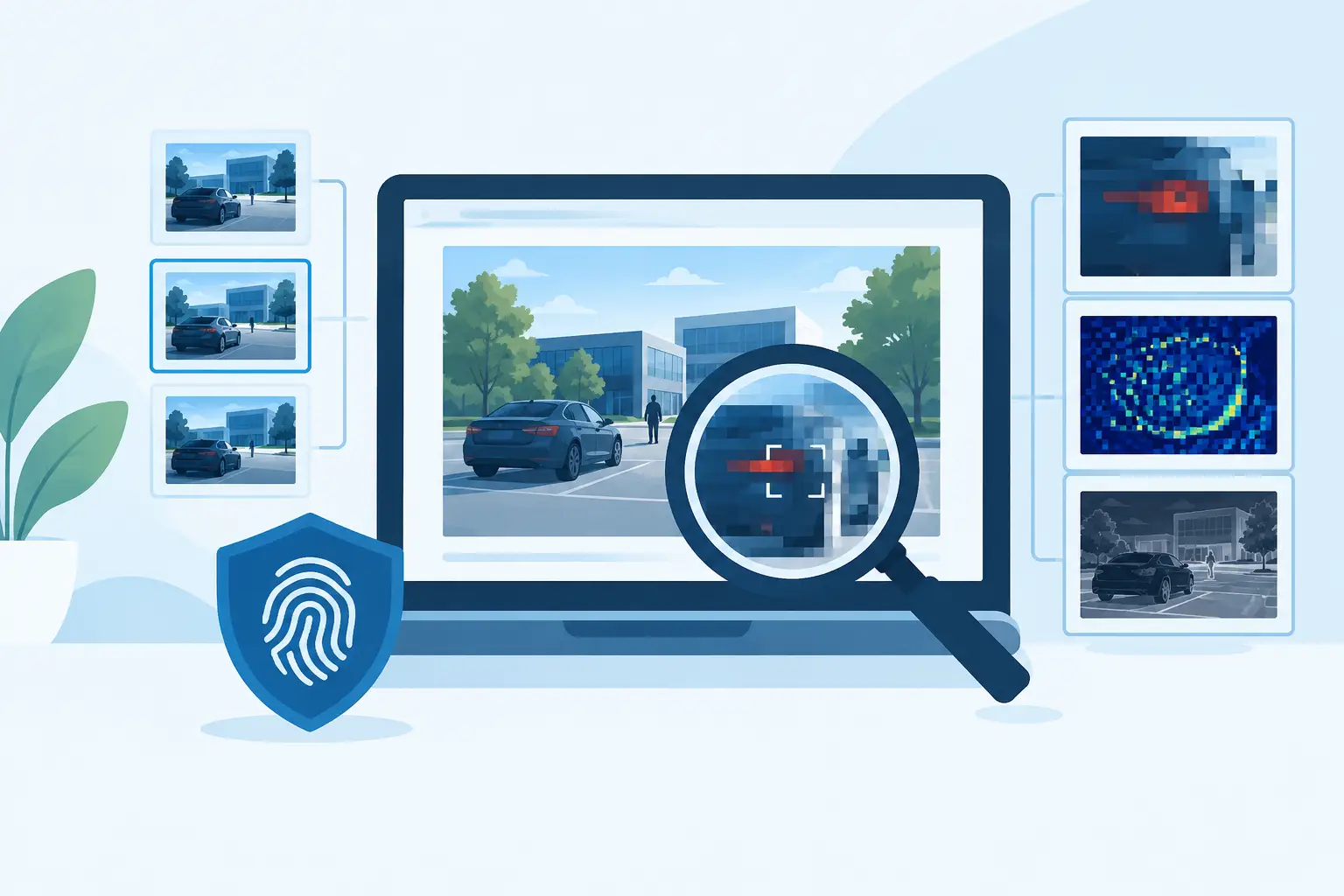
A blurry CCTV frame can trigger a serious question in minutes: Is this person connected to a prior incident, a credible safety concern, or simply someone who looks similar at a glance? Image forensics gives security and investigation teams a disciplined way to answer that question without treating a single image, match signal, or social post as a final determination.
For property teams, corporate security, and investigators, the goal is not to turn every unknown face into an identity. The goal is to preserve what was captured, test what it can reliably support, document the reasoning, and escalate only when the facts justify it. That distinction protects people, preserves credibility, and makes incident response faster when a real threat emerges.
What Image Forensics Means in a Security Workflow
Image forensics is the practice of examining an image for evidence about its origin, condition, content, and credibility. In an operational setting, that can include reviewing a CCTV export, checking whether a photo has been altered or recompressed, comparing visible details across frames, and validating whether a possible match is actually relevant to the incident.
It is not one tool and it is not a magic identity button. A face search may return a confidence-scored signal. Metadata may reveal when a file was created or exported. Visual review may show clothing, tattoos, vehicles, direction of travel, or whether the image has been cropped in a misleading way. Each finding has a different evidentiary value.
That is why professional image review starts with a simple rule: separate leads from conclusions. A search result can justify further review. It does not, by itself, establish that a person was present, involved, or responsible for an event.
Start With the Original File, Not the Screenshot
The fastest way to weaken an investigation is to work from an undocumented screenshot that has been forwarded through multiple phones and chat threads. Every export, crop, markup, compression pass, and social upload can remove context or introduce artifacts.
Preserve the earliest available version of the image or video frame. Record where it came from, who provided it, when it was received, and what system created it. If the source is a camera system, retain the relevant clip where possible, not only the still frame. A few seconds before and after the captured image can establish direction, companions, access points, and behavior that a single frame cannot show.
Create a working copy for enhancement and annotation. Keep the original unchanged. This is not unnecessary formality. If a case moves from internal triage to law enforcement handoff, insurance review, counsel, or management scrutiny, a clean record of what was received and what was done to it matters.
Review What the Image Can Actually Support
A high-resolution badge photo and a low-light parking-lot frame should not be reviewed with the same expectations. Image quality determines how much confidence an analyst can reasonably assign to a finding.
Start with the basics: Is the face visible and sufficiently large? Is it frontal, partially obscured, motion-blurred, overexposed, or distorted by a wide-angle camera? Are there multiple frames that show the subject from slightly different angles? Is the timestamp reliable, and does it align with access logs, dispatch records, or witness accounts?
Then examine stable, observable details. Clothing can be useful when an event has a narrow time window, but it changes easily and should rarely carry a conclusion alone. A distinctive backpack, footwear, vehicle, gait, or repeated movement pattern may add context. So can a comparison of the same subject across several cameras.
Enhancement can improve visibility, but it has limits. Brightening shadows, correcting contrast, or enlarging an image may help an investigator see what is already present. It cannot responsibly create details that the camera did not capture. Treat aggressively sharpened facial features, artificial detail generation, and heavily filtered images with particular caution. They can look persuasive while becoming less faithful to the original evidence.
Use Match Signals as Leads, Then Verify Context
Reverse image and face-matching workflows are valuable because they reduce the time spent searching for possible connections. They are especially useful when a team needs to determine whether an image may relate to a public post, a known prior incident, or a person who has already raised a documented safety concern.
But a possible visual match is only the beginning of the review. Analysts should compare the source image and candidate image directly, examine the date and location context of the source, and ask whether the result is relevant to the specific incident. A person appearing in a public image years earlier does not establish where they were last night.
This is where human-in-the-loop review is non-negotiable. Check for look-alike risk, image age, alternate explanations, and discrepancies in physical characteristics or context. When confidence is limited, label the finding accordingly: possible lead, unverified similarity, or insufficient evidence. Clear language prevents an early hypothesis from becoming an unexamined fact as it moves through a team.
SafetyCamAI is designed around this verification-first model: upload a photo or CCTV frame, review confidence-scored match signals from permitted public sources, inspect source context, and export the evidence needed for appropriate escalation. The operational value is speed with an audit trail, not automated accusation.
Build an Evidence Package Someone Else Can Review
Good image forensics should make a case easier for the next reviewer to understand. A security director, property owner, attorney, law enforcement contact, or daytime shift supervisor should not have to reconstruct an analyst’s logic from a folder of unlabeled screenshots.
An evidence package should preserve the original file reference, relevant timestamps, camera or source location, analyst notes, and the exact images used for comparison. If a public-source result is relevant, retain the source reference and the reason it matters. Note what supports the lead and what remains unverified.
A concise incident narrative is usually more useful than a large volume of unorganized material. State what happened, when it happened, which image was reviewed, what the analysis found, and what action was taken. For example, a defensible note might say that a candidate image showed visual similarities but could not be confirmed from the available CCTV quality, so the finding was retained for awareness and not used as the basis for a punitive action.
That level of precision is not timid. It is what makes the documentation credible.
Decide When to Escalate and When to Stop
The right response depends on the risk, the quality of the evidence, and the authority of the team reviewing it. An apparent trespasser near a restricted area may justify a focused patrol, access-control review, and preservation of related footage. A possible connection to a prior threat may warrant prompt consultation with security leadership or law enforcement. A weak resemblance with no corroborating facts may warrant no action beyond retaining the material under the organization’s retention policy.
Escalation should be proportionate. Avoid publishing identities, sharing images beyond those who need them for a legitimate security purpose, or making employment, housing, credit, insurance, or other consumer decisions from a search signal. A verification platform is not a consumer reporting agency, and image-based intelligence should not be used as a substitute for lawful background-screening processes or due process.
The same discipline applies to retention. Keep material only as long as your policy, contractual obligations, and applicable law support. Restrict access, document handoffs, and avoid collecting more personal information than the incident requires. Security teams earn trust not only by finding credible risks quickly, but by knowing where their authority ends.
Make Review Repeatable Across Your Team
The strongest workflows are repeatable under pressure. Define who can submit images, who can review potential matches, what evidence is required before an escalation, and who approves external sharing. Train staff to use calibrated language rather than declaring certainty from a low-quality frame.
A practical standard is to require corroboration for consequential decisions. That may be a clearer second frame, access-control data, a witness statement, a vehicle association, a verified source date, or a direct comparison that rules out material differences. The exact threshold depends on the incident, but the principle remains the same: higher stakes require stronger support.
When an unknown person appears in a frame, speed matters. So does restraint. The teams that handle both well turn images into actionable safety signals while leaving a record that can withstand the next question.