

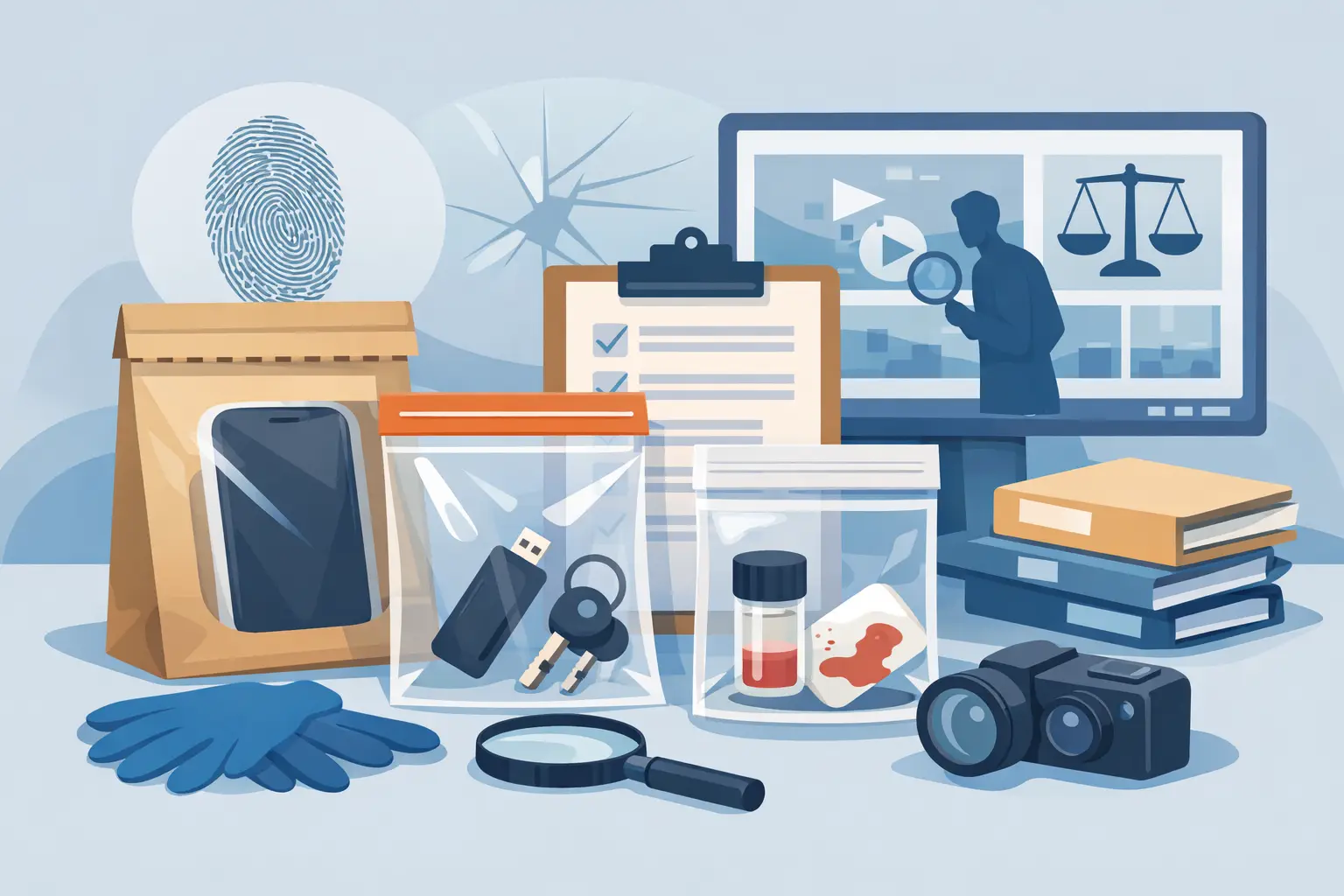
A blurry CCTV frame can trigger a legitimate safety concern. It cannot, on its own, support a fair or defensible conclusion. Evidence packaging for incident review is the discipline of turning a raw image, an investigative lead, and the surrounding facts into a record another authorized reviewer can understand, verify, and act on.
That distinction matters when an incident moves quickly. A property manager may need to decide whether to increase patrols, preserve footage, issue a trespass notice through the appropriate process, or contact law enforcement. Corporate security may need to determine whether a person seen near a restricted area is connected to an earlier event. In each case, speed matters. So do accuracy, privacy, and a documented human decision process.
What a review-ready evidence package contains
A useful package does not try to prove more than the evidence supports. It separates observed facts from analytical signals and keeps the path from source material to recommendation visible.
Start with the incident record: the date and time, location, reporting party, camera or device identifier, and a short description of what was observed. Preserve the original image or video clip in accordance with your retention policy. Then create working copies for analysis so the source file remains intact.
The package should also identify the specific frame or frames under review. Record why they were selected, whether they were cropped, enhanced, or extracted from a longer clip, and what limitations affect their quality. Low light, motion blur, an obstructed face, an unusual angle, and compression artifacts should be stated plainly. These are not minor technical footnotes. They determine how much weight a reviewer can reasonably place on an image-based signal.
When a permitted public-source search produces a possible match, include the confidence-scored result, the source context, the search date, and the analyst’s notes. A match signal is an investigative lead, not an identity determination. The evidence package should make that boundary unmistakable.
Build the package in the order reviewers think
Incident reviewers rarely have time to reconstruct an analyst’s process from scattered screenshots and messages. Organize the record in the order a supervisor, client, or responding partner will need it.
1. Establish what happened
Open with a concise incident narrative. Keep it factual: who reported the event, what was observed, where it occurred, and when. Avoid loaded labels such as “suspect” or “offender” unless the status is established by the relevant authority or your organization has a documented reason to use them.
A stronger statement is: “An unidentified individual entered the west loading area at 2:14 a.m. and remained near the access-control panel for approximately three minutes.” It tells the reviewer what can be seen without assigning motive or identity.
2. Preserve the visual record
Include the original file reference, camera name, timestamp, time-zone setting, and any known clock discrepancy. If footage was exported from a video management system, document who performed the export and when. If the system generates hashes or audit logs, retain them with the case record.
For stills, label each image clearly. A reviewer should be able to tell whether an image is the original frame, a crop, or an annotated working image without guessing. Annotations can be useful for showing a direction of travel, clothing detail, or point of entry, but they should never obscure the underlying image. Keep the unmarked version alongside it.
3. Document the search and verification path
If an authorized analyst used a face image to look for relevant public-source context, record the input image used, the date and time of the search, and the result set reviewed. Capture the result in a way that preserves the displayed confidence signal and associated source context.
The analyst should explain the basis for any relevance judgment. For example: a result may show visual similarity, but the associated post may be from a different city, a date that does not align, or an account with insufficient context. Those facts may reduce relevance. Conversely, a source may align with a known location, distinctive clothing, a public event, or a documented prior incident. That is context for review, not permission to skip verification.
4. State the recommended next action
The last section should answer an operational question: what should happen next, and who has authority to decide? Recommendations should be proportionate to the evidence.
A low-quality frame with a weak contextual signal may justify preserving video, checking access logs, or increasing observation. A stronger package that includes consistent source context and corroborating onsite information may justify internal escalation, a call to counsel, or a law-enforcement handoff. The right action depends on the incident, local law, contractual obligations, and your organization’s policies.
Keep facts, signals, and conclusions separate
The most common packaging failure is blending these categories until a possible lead reads like a confirmed fact. That creates unnecessary risk and makes later review harder.
Facts are directly observed or independently recorded: the time of entry, a badge-access denial, a vehicle description, or the footage itself. Signals are analytical outputs: a visual similarity score, a possible public-source result, or a pattern noticed by an investigator. Conclusions are decisions made by authorized people after considering the record.
Use labels that enforce this separation. “Observed,” “match signal,” “corroborating information,” and “recommended follow-up” are clearer than a single narrative that jumps from an image to an accusation. This approach also protects the people involved. A reviewer can see what is known, what is uncertain, and what remains to be verified.
Evidence packaging for incident review needs a human in the loop
Automation can reduce the time required to organize files and surface potential context. It cannot decide whether an individual is the same person shown in footage, whether a source is reliable, or whether an action is lawful and proportionate.
That is why the reviewer identity matters. Record who ran the search, who assessed the result, who approved escalation, and when each action occurred. A basic chain of custody is not bureaucracy for its own sake. It shows that the organization handled sensitive material deliberately and did not let an unreviewed system output drive a high-impact decision.
SafetyCamAI is designed around this verification-first workflow: upload a relevant image, review confidence-scored signals and source context, then export the record for an authorized human decision. Teams should still apply their own policies, retention schedules, and legal requirements to every case.
Make escalation defensible, not dramatic
Not every incident requires a full investigative packet. A minor policy violation may need only an internal note and preserved footage. A credible threat, repeated trespass pattern, or serious safety event may require a more complete record, faster supervisory review, and communication with appropriate authorities.
The trade-off is practical. Under-documenting can leave a team unable to explain why it acted. Over-collecting can create privacy exposure, confuse the case, and keep sensitive material longer than necessary. Build packages that are sufficient for the decision at hand, then follow your retention and access-control policies.
Before sharing outside the organization, verify that the recipient has a legitimate need and appropriate authority. Limit disclosure to relevant material. Do not treat image-based findings as consumer reporting, employment screening, tenant screening, or an automated basis for adverse action. Safety and incident triage belong in a public-interest lane with defined guardrails.
A simple quality check before handoff
Before a package leaves the case folder, ask four questions. Can a new reviewer identify the original evidence and understand its limitations? Can they distinguish a match signal from a verified fact? Can they see what source context was considered and why it mattered? Can they tell who made the escalation decision?
If the answer to any of those questions is no, the package is not ready. Add the missing context before the record travels further.
The goal is not to create a thicker file. It is to create a clearer one: a record that helps the next authorized person verify faster, respond proportionately, and protect people without overstating what the evidence shows.