

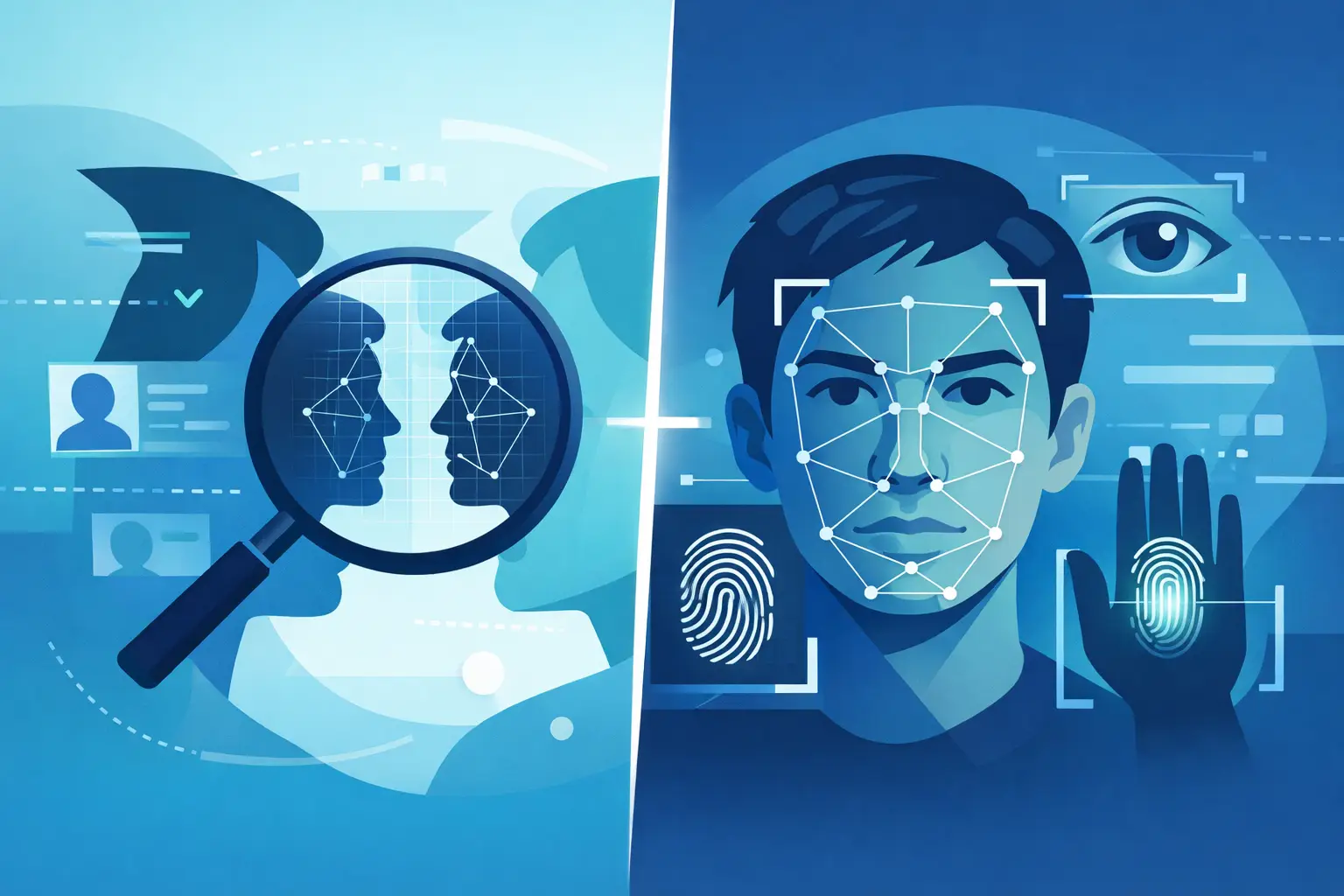
A clear CCTV frame can answer an urgent operational question: does this person appear in other permitted public material, and does that signal justify a closer review? That is where facial matching versus biometric identification becomes more than a technical distinction. The terms are often used interchangeably, but they describe different outputs, risks, and decision thresholds.
For security teams, investigators, and property operators, the difference shapes the workflow. A match signal can help prioritize a case. It should not become an automatic identity determination, an eligibility decision, or a substitute for human judgment.
Facial Matching Versus Biometric Identification: The Core Difference
Facial matching compares a submitted face image with other face images to assess visual similarity. The input may be a CCTV still, a photo from an incident report, or an image captured during a permitted review. The output is generally a set of possible visual matches, often accompanied by confidence information and the source context in which the comparison image appeared.
Biometric identification is broader and generally carries a higher-stakes meaning. It uses a biometric characteristic, such as a face, fingerprint, iris, voice, or gait, to determine or confirm that a person is a specific individual. Depending on the system and use case, it may involve comparing a probe image against a known database or template repository to return one identity from many possible candidates.
That distinction matters because a visual similarity result is not the same thing as a verified identity. A face may look similar across images due to angle, resolution, lighting, age, occlusion, or simple human resemblance. Even a strong result needs contextual validation: Is the source current? Does the location fit? Are there corroborating details? Is the image quality sufficient to support the proposed conclusion?
In practical terms, facial matching supports triage and verification. Biometric identification may support identification where there is a lawful basis, a fit-for-purpose system, a defined database, and an appropriate decision process. The first can help a team decide where to look next. The second can carry consequences that demand greater controls.
Why the Label Changes the Workflow
A team reviewing a trespass incident may need to compare an unknown individual’s face against permitted public-source images or prior incident materials. The immediate goal is not necessarily to declare a legal identity. It is to understand whether there is a credible connection worth documenting and escalating.
That is a facial matching workflow. Upload the best available image, review candidate signals, inspect the image context, and preserve the basis for any escalation. The reviewer remains responsible for deciding whether the evidence is relevant and sufficiently reliable.
A biometric identification workflow starts from a different premise. It often assumes access to a curated gallery of known identities, enrollment templates, or records tied to named people. It may be used for access control, secure facility entry, identity verification, or other functions where a system is expected to distinguish one person from a defined population.
Neither approach is automatically better. The right approach depends on the question, the data available, the legal authority for processing it, and the potential impact of being wrong. Conflating the two creates avoidable risk. Calling a candidate match an identification can overstate certainty. Treating every face search as harmless can understate privacy and compliance obligations.
What a Professional Facial Matching Workflow Should Produce
For operational security work, useful results must be reviewable. A bare assertion that two faces are alike does not give an investigator much to work with. A defensible workflow should preserve the original submitted image, candidate images, confidence-scored similarity signals, source context, timestamps, reviewer notes, and the reason for any next step.
This is especially relevant when the initial image comes from CCTV. Camera footage is often imperfect. Faces may be partially covered, captured at an angle, blurred by movement, or compressed by the recording system. A platform should communicate uncertainty rather than mask it behind a single definitive answer.
Human review is the control that turns a fast signal into responsible action. The reviewer can compare distinctive features across images, assess whether the source context supports the apparent connection, and seek independent corroboration before making a report or escalating an incident. If the evidence is weak, the correct outcome may be no action.
SafetyCamAI is built around that verification-first approach: turn photos and CCTV frames into actionable signals, preserve the supporting record, and keep a human in the loop before any operational decision is made.
Confidence Scores Are Not Identity Scores
A confidence score can be valuable, but only when its meaning is understood. In a facial matching process, a score typically reflects the system’s assessment of visual similarity between images. It does not prove the person’s legal name, intent, history, or relationship to an incident.
Operational teams should treat high-confidence results as higher-priority review candidates, not as automatic conclusions. Lower-confidence results may still contain useful leads in some circumstances, but they require even more careful validation. Image quality, source quality, and the consequences of error should influence how much weight a team gives any result.
The most reliable operational habit is simple: match, review, corroborate, document. Skipping the middle steps turns a useful investigative aid into an unsupported claim.
Where Biometric Identification Requires More Caution
Biometric data is sensitive because it is tied to the body and cannot be changed like a password. Laws, contractual terms, and organizational policies may impose requirements around notice, consent, retention, security, access controls, and permitted purpose. These obligations can vary by state and by the exact activity being performed.
For example, a system used to control entry to a building may create, store, and compare face templates for enrolled employees or authorized visitors. That is fundamentally different from reviewing a single incident image for potential public-source matches. The data lifecycle, the expectations of the individuals involved, and the governance requirements are not the same.
Teams should also separate safety and investigative uses from consumer reporting. A facial matching result should not be used to make decisions about employment, housing, credit, insurance, or similar eligibility matters. It should not be treated as a background report or used as a shortcut around legally required screening processes.
The public-interest lane is narrower than many teams assume. A legitimate safety purpose does not eliminate the need for lawful collection, access restrictions, retention limits, and documented procedures. It means the team has a reason to build those controls into the process from the start.
Choosing the Right Approach for the Incident
When an unknown person appears in a parking-garage camera feed, start with the operational question. Is the team trying to determine whether the same individual appears in prior incidents? Is it trying to establish a name from an authorized internal gallery? Is the issue immediate safety, post-incident documentation, or access verification?
If the task is incident triage, facial matching may be the more appropriate tool. It can surface candidate connections without pretending that an image alone settles identity. The reviewer can then compare materials, assess context, preserve evidence, and decide whether to involve law enforcement, legal counsel, or internal security leadership.
If the task is controlled identity verification, biometric identification may be appropriate only after the organization has addressed enrollment, notices, permissions, security controls, vendor obligations, and applicable law. A strong use case is not enough by itself. The program must also be designed to withstand scrutiny.
This decision should not be left to an individual analyst under pressure. Teams benefit from clear escalation rules: what can be searched, who may review results, when a finding needs secondary validation, how long evidence is retained, and when an outside authority must take over.
Build for Defensible Decisions, Not Fast Labels
Speed matters after an incident. A property manager may need to determine whether a suspicious person seen near a loading dock appears connected to earlier reports. A corporate investigator may need to organize evidence before a threat assessment meeting. But speed has value only when the team can explain what it found, how it evaluated the result, and what it did next.
That is the practical dividing line in facial matching versus biometric identification. Facial matching provides a signal for review. Biometric identification seeks to establish or confirm who someone is. Both can have legitimate roles, but each demands a workflow calibrated to its level of certainty and consequence.
Treat every result as the beginning of disciplined verification, not the end of it. The teams that protect people best are the ones that move quickly, preserve context, and know when a face match is a lead rather than a label.