

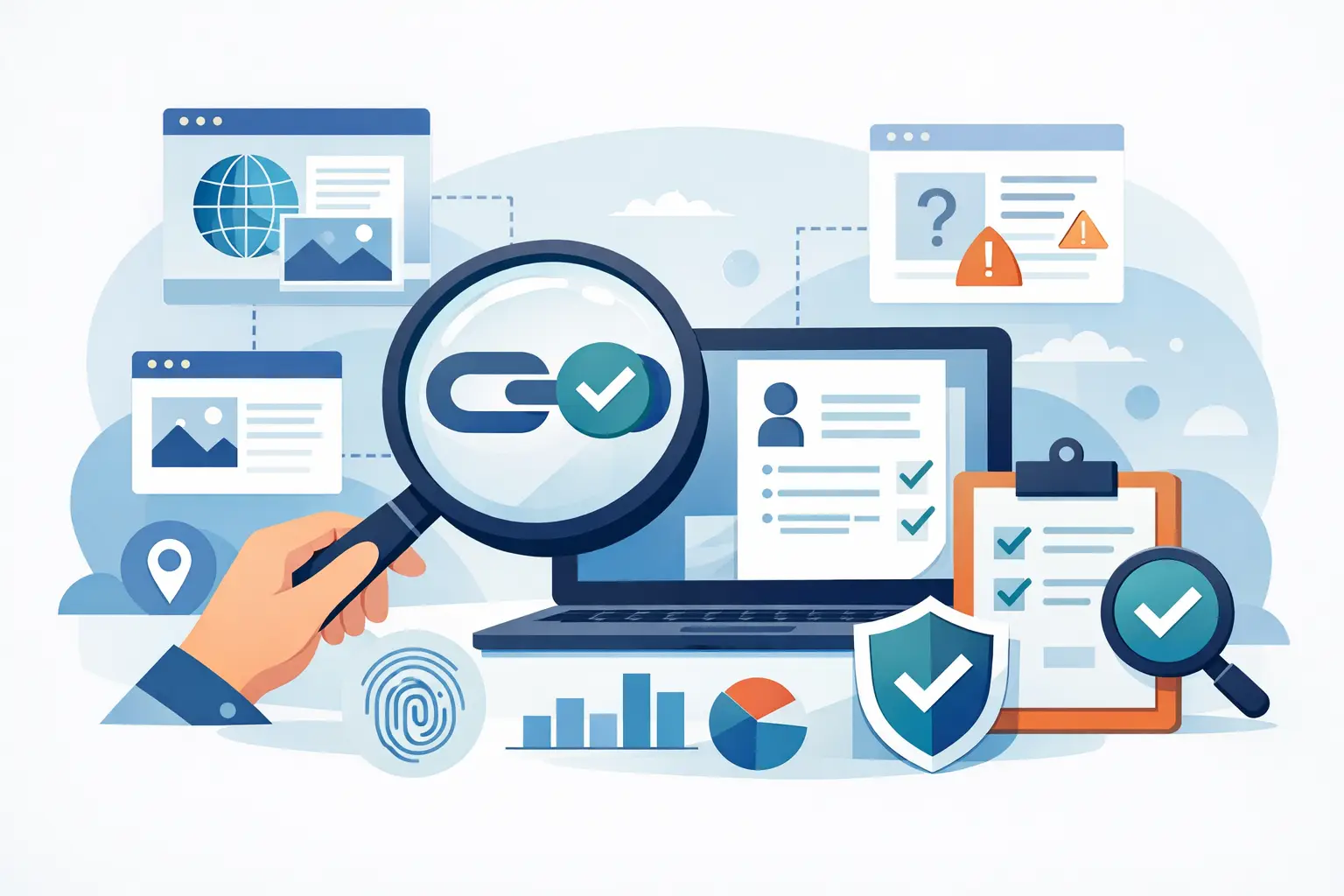
A source link is not evidence just because a tool returned it.
That distinction matters in every real investigation workflow. If you are deciding how to validate investigation source links, the goal is not to collect more URLs. It is to determine whether a link actually supports the identity, context, and timeline you may later rely on in an incident report, internal escalation, or law enforcement handoff.
For security teams, investigators, and property operators, bad link validation creates two kinds of risk at once. First, you can miss a real threat because the context was misread or the source was stale. Second, you can overstate confidence based on weak or mismatched material. A fast signal has value, but only when a human in the loop confirms what the link truly shows.
What it means to validate investigation source links
Validation is the process of checking whether a returned source link is authentic, relevant, current enough for your use case, and actually connected to the person or incident under review. In practice, that means you are not asking, “Did the system find something?” You are asking, “Can I defend why this source matters, what it proves, and what it does not prove?”
A valid source link usually clears four tests. The page exists and appears genuine. The page content matches the face, account, or event you are reviewing. The timing makes sense for the incident window. And the page adds usable context instead of noise.
That last point gets overlooked. A link can be real and still be operationally useless. If it cannot help you narrow identity, establish location, support pattern-of-life review, or document escalation rationale, it may not belong in your evidence package.
How to validate investigation source links in a real workflow
The strongest workflows move from image match to source review to documentation. They do not jump from a confidence score to action.
Start with the returned link itself. Check the domain, page structure, and whether the content looks native to the platform it claims to be on. Fake profile pages, scraped mirrors, and repost sites can all create false confidence. If the page has broken formatting, inconsistent handles, odd URL patterns, or content that appears copied from another source, slow down.
Next, compare the face on the linked page to the reference image you started with. Do not stop at a broad resemblance. Focus on stable visual features rather than hairstyle, lighting, or age-sensitive presentation. Ear shape, nose structure, eye spacing, and jawline are more dependable than clothing or temporary styling. If your source image came from CCTV, be especially cautious. Angle distortion, compression, and motion blur can make weak matches feel stronger than they are.
Then validate the surrounding context on the page. Usernames, captions, comments, location tags, repost behavior, and profile history all matter. A profile image may resemble your subject, but the account activity may clearly indicate a different person, age range, geography, or social circle. That is a disqualifier, not a minor inconsistency.
After that, check time relevance. A real profile from six years ago may still be useful for identity development, but it may be weak support for current location or recent activity. You need to separate identity confirmation from timeline confirmation. Those are related, but they are not the same claim.
Finally, record what the link supports and what it does not. This is where defensibility comes from. If the source suggests a likely match but does not independently confirm identity, say that. If it supports location context but not involvement in the incident, say that too. Clean boundaries protect your team.
The checks that matter most
In most investigations, source link validation comes down to authenticity, identity fit, contextual fit, and preservation.
Authenticity is about whether the page is likely original and unaltered enough to rely on. Look for normal platform behavior, coherent account history, and consistency between the visible page and the URL. Screenshot-only findings are weaker than live-source findings unless you can explain why the live page is gone and what preservation steps were taken.
Identity fit is where many teams overreach. A linked profile does not become your subject because the algorithm surfaced it. You need corroboration inside the page itself. That may include repeated facial consistency across multiple posts, matching tattoos or accessories visible in surveillance, associations with a relevant location, or overlapping biographical details. One matching headshot is thin support. A pattern across the account is much stronger.
Contextual fit asks whether the link helps answer the operational question in front of you. If you are reviewing a trespass incident at a multifamily property, a source page tied to the right city, social group, or repeated appearance near the property may matter. A similar-looking account from another state may not. Relevance is not abstract. It is case-specific.
Preservation matters because links disappear, content changes, and memory gets selective. Capture the page, the timestamp of access, the visible handle, and the exact reason it was retained. If your team exports evidence, include the source link, the reviewed image, the date accessed, and your validation notes. That creates an audit trail instead of a loose pile of screenshots.
Common validation mistakes
The biggest mistake is treating confidence scores as conclusions. A confidence score is a triage signal, not a final identification. High confidence can still point to the wrong person if the source material is low quality or the linked page lacks corroborating context.
The second mistake is relying on reposted images. Faces travel. The same photo may appear on news pages, gossip blogs, fan accounts, or scraped directories unrelated to the actual person. If the source page is merely republishing an image from somewhere else, it may tell you nothing about the subject beyond the fact that the image was copied.
A third mistake is ignoring platform behavior. Accounts get renamed, sold, abandoned, or impersonated. A handle that looks relevant today may have belonged to a different user earlier. Validation should account for signs of continuity, not just surface appearance.
The fourth mistake is skipping the negative evidence. If the page contains details that cut against your theory, document them. Investigations become more reliable when disconfirming facts are taken seriously. That discipline is part of staying in the public-interest lane and avoiding speculative reporting.
When a source link is strong enough to act on
Acting on a source link depends on the action. Internal triage needs a different threshold than eviction review, employment screening, or any decision with legal consequences. That is where compliance guardrails matter.
For internal safety escalation, a validated source link may be enough if it supports a reasonable, documented concern and triggers further review rather than final action. For anything that could materially affect a person’s housing, employment, benefits, or similar status, the standard is higher and the workflow must reflect lawful use restrictions. A verification-first platform can help you surface and organize signals, but it should not be treated as a consumer reporting agency product or a substitute for required procedures.
That means the right question is not, “Can we do something with this link?” It is, “What action is appropriate given what this link actually proves?”
Building a defensible review standard
The best teams standardize source-link review so individual urgency does not distort judgment. A simple internal standard works well: every retained link must have a reviewer, a reason for relevance, a note on confidence, and a note on limitations.
If you are using AI-assisted face matching, keep the human in the loop at the point where source links are interpreted. This is where tools save time without replacing judgment. A system can surface candidate sources quickly. The reviewer decides whether the source is authentic, whether the identity fit is credible, and whether the context justifies escalation.
This is also where operational speed and discipline can coexist. Platforms such as SafetyCamAI are useful when they help teams move from upload to match to source review without blurring the line between signal and proof. That distinction is what keeps investigations useful under pressure.
A practical threshold for everyday cases
If you need a working rule, use this one: do not rely on a source link unless it answers at least two of these three questions with documented support – who, where, and when.
Who asks whether the linked page is credibly tied to the same person in your reference image. Where asks whether the source has a meaningful connection to the relevant property, region, or operating environment. When asks whether the timing lines up closely enough to support the use case at hand. One out of three is usually too thin. Two may justify internal follow-up. Three is stronger, but still not a license to skip review.
Good investigations are not built on the first match returned. They are built on disciplined validation, recorded limits, and actions that fit the evidence. The link is the start of the check, not the end of the decision.