

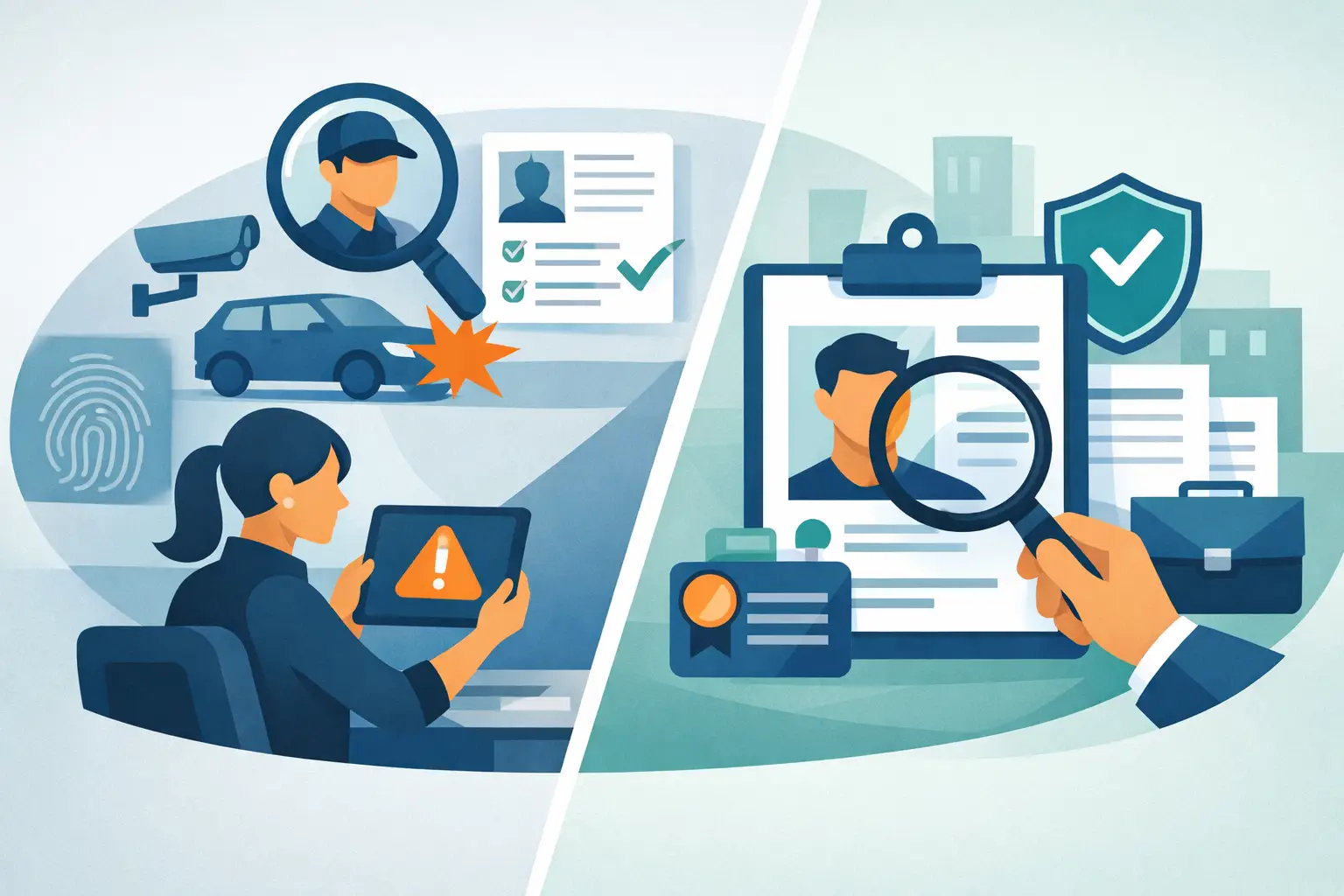
A grainy CCTV frame, a tenant complaint, or a photo pulled from an incident report creates an immediate operational question: is this person connected to a real safety concern, and what should the team do next? Incident verification vs background screening is not a choice between two versions of the same process. They solve different problems, carry different compliance obligations, and should lead to different decisions.
For security teams, investigators, and property operators, the distinction matters because the fastest path to a name is not always the right path to a defensible action. Incident verification is built to assess a specific event and determine whether escalation is warranted. Background screening is generally built to evaluate an individual for an employment, housing, credit, insurance, or similar eligibility decision.
What incident verification is designed to answer
Incident verification begins with a defined event. A person is seen tailgating into a restricted area. A package room is vandalized. A resident reports harassment and provides a photo. A corporate security team receives an image connected to a credible threat.
The operational question is narrow: can available, lawfully accessed information help validate identity, context, risk, or a connection to the reported incident? The goal is not to build a complete personal profile. It is to establish enough reliable context for an appropriate next step, such as preserving footage, increasing site awareness, contacting law enforcement, interviewing a witness, or closing a false lead.
A disciplined incident-verification workflow typically starts with the image and the event record. Teams should retain the original frame where possible, note the time and location, document who supplied the image, and preserve relevant surrounding footage. Those details often matter as much as a possible identity signal. A face match without time, source, or corroborating context is a lead, not a conclusion.
SafetyCamAI is structured for this public-interest lane: upload a permitted photo or CCTV frame, review confidence-scored signals from permitted public sources, inspect source context, and keep a human in the loop before any escalation. The output supports triage and evidence packaging. It does not replace investigative judgment.
The standard is verification, not certainty
Facial similarity, a matching public image, a location reference, or a social post can help a reviewer move from unknown to potentially identifiable. Each signal still needs validation. Images may be old, reposted, mislabeled, altered, or associated with a different person who looks similar.
That is why incident verification should be evidence-led. Review the source page, compare multiple images, check dates and geography, and ask whether the signal is consistent with the known facts. If it is not, document the uncertainty instead of forcing a match. A careful “unable to verify” finding can prevent a damaging and unnecessary escalation.
What background screening is designed to answer
Background screening has a different purpose. It is commonly used when an organization must decide whether someone is eligible for a job, apartment, contract role, credit product, insurance arrangement, or another consumer-facing opportunity.
That process may involve identity verification, employment and education history, criminal-record searches, driving records, or other defined checks. It is governed by the purpose of the decision and, in many situations, by federal, state, and local rules. When a third party assembles or provides consumer-report information for eligibility decisions, the Fair Credit Reporting Act can apply. State laws, local fair-chance rules, privacy requirements, and sector-specific obligations may add further limits.
The practical point is simple: a screening decision requires process controls that a live incident review does not automatically provide. Depending on the use case, that can include permissible purpose, proper disclosure and authorization, source accuracy standards, individualized assessment, and adverse-action procedures. A security team should not treat a quick image-based lead as a substitute for a compliant screening report.
SafetyCamAI is not a consumer reporting agency, and its signals are not intended for employment, housing, credit, insurance, or other consumer eligibility determinations. Keeping that boundary clear protects both the organization and the people affected by its decisions.
Incident verification vs background screening: the operational difference
The easiest way to separate the two is to look at the trigger, the data, and the action.
Incident verification is triggered by a specific safety event. It uses the evidence relevant to that event, including photos, CCTV frames, witness information, access logs, and lawfully available public-source context. Its action is operational: assess, document, monitor, investigate further, notify the right party, or escalate where justified.
Background screening is triggered by a proposed eligibility decision. It uses information permitted and appropriate for that decision. Its action is evaluative: approve, deny, condition, or otherwise determine eligibility within a controlled legal and policy framework.
The two workflows can occasionally touch the same person, but that does not make them interchangeable. If an applicant is captured on camera during a credible security incident, the incident itself may need investigation. The organization should still keep that investigation separate from any hiring or housing decision and route each process through the appropriate controls.
Where teams create avoidable risk
The biggest mistake is purpose drift. A team starts with a legitimate incident question, then expands the search into broad personal profiling or uses unverified results to make an eligibility decision. That shift can create privacy, fairness, and compliance exposure quickly.
Another mistake is treating an automated result as a final identification. AI-assisted matching can make review faster, particularly when an investigator has a limited CCTV frame and an urgent need for context. It cannot establish intent, prove involvement, or eliminate the possibility of error. A human reviewer must assess image quality, confidence level, source reliability, and the full incident record.
Finally, teams often fail to preserve their reasoning. A screenshot alone is weak documentation. A defensible file explains what was observed, when it was observed, what source supported the finding, who reviewed it, what uncertainty remained, and what action followed. That record makes internal handoffs cleaner and helps leadership evaluate whether escalation was proportionate.
A verification workflow that holds up under review
Start by defining the incident in one or two sentences. Identify the safety concern, location, time window, and the decision the team needs to make. This prevents a broad search from becoming an unfocused investigation.
Next, preserve the source material. Save the original image or video segment, record any relevant camera identifier, and maintain the chain of custody your organization requires. Use the clearest available face frame, but do not crop away details that could later establish timing or scene context.
Then review match signals as leads. Compare facial features across more than one image where possible. Open and assess the supporting source. Look for corroboration from independent facts, not merely several reposts of the same image. If a result is ambiguous, say so plainly in the case notes.
After that, decide on the least intrusive appropriate action. A low-confidence or weakly corroborated signal may justify additional footage review or a request for witness clarification. A credible, well-documented threat may justify immediate security measures or a law-enforcement handoff. The action should reflect the risk, the evidence, and the organization’s authority.
Close the record with an exportable evidence package. Include the incident facts, reviewed images, source references, reviewer notes, confidence assessment, and escalation decision. Limit access to people with a legitimate operational need, follow retention policies, and consult qualified counsel or compliance leadership when the use case crosses into a regulated decision.
Choose the process that matches the decision
If the question is, “Who may be connected to this reported incident, and do we need to act now?” incident verification is the relevant workflow. If the question is, “Should this person receive a job, lease, credit, or another opportunity?” background screening is the relevant workflow, with the controls that decision requires.
That line is not bureaucratic friction. It is what lets security teams move quickly without confusing a lead for a verdict. Build the decision record before the decision, keep a human in the loop, and escalate only on evidence your organization can explain.