

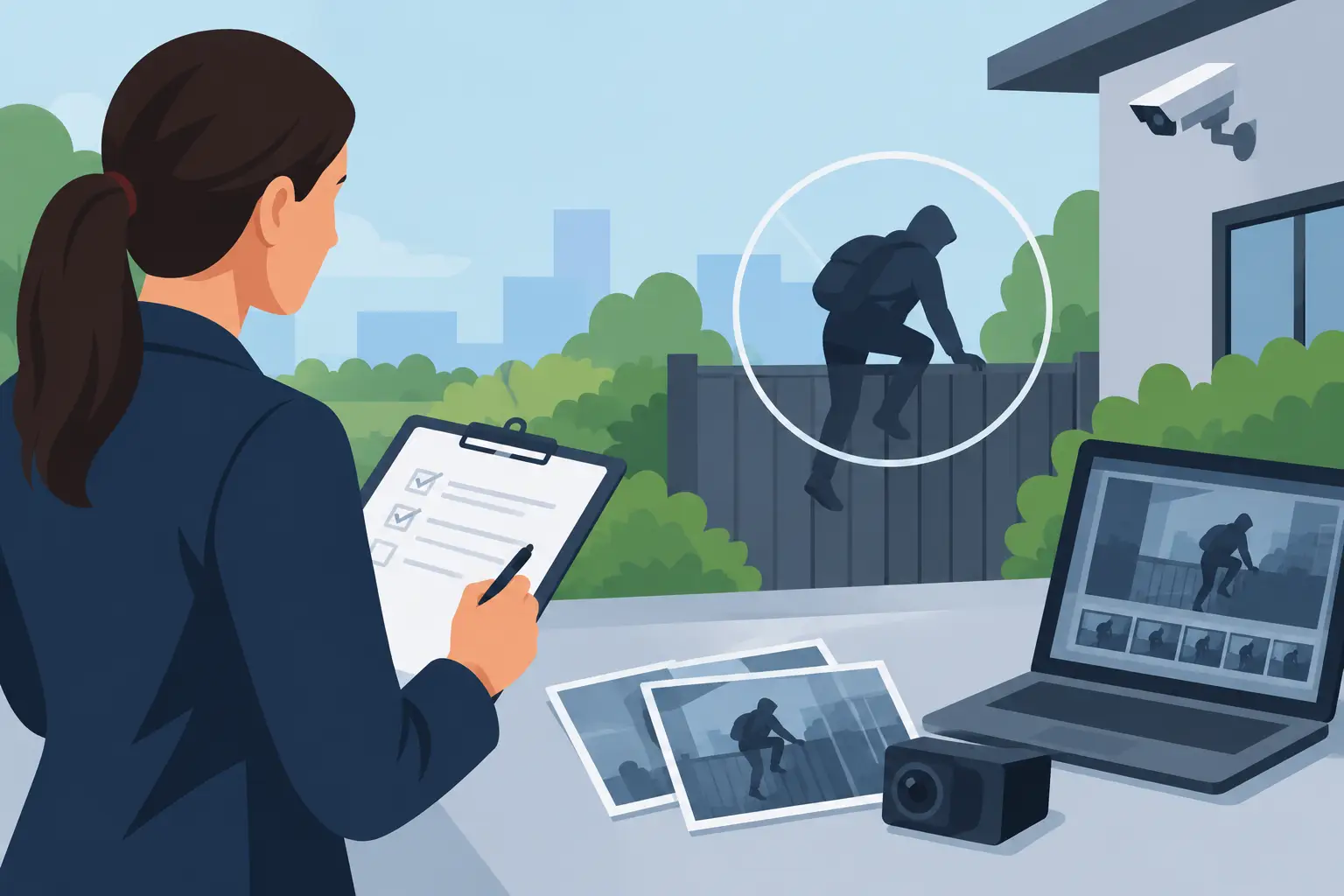
A person appears behind a locked gate at 2:13 a.m. The camera image is usable but not perfect. By morning, the question is not simply, “Who is that?” It is whether the incident justifies action, whether the person had permission to be there, and whether your team can document its decisions if the matter escalates.
A trespass identification case is strongest when identification work supports a disciplined incident process. A possible facial match may help investigators prioritize leads, but it does not establish unlawful entry, intent, or identity on its own. Professional teams preserve the original footage, verify context, document every review step, and escalate based on evidence rather than assumption.
Start With the Trespass Facts, Not the Face
Trespass is a legal conclusion, and its elements vary by state and local jurisdiction. A person on private property is not necessarily trespassing just because they look unfamiliar in a camera frame. They may be a tenant, guest, contractor, delivery driver, former employee with residual access, or someone responding to an emergency.
Before initiating identification work, establish the operational facts. What property was involved? Was it posted, fenced, locked, or otherwise restricted? Was there a prior warning, revoked permission, or active exclusion order? What time did the individual enter, where did they go, and how did they leave?
This foundation changes the value of a match signal. A clear image of someone walking through a public-access lobby may warrant routine review. The same person entering a locked maintenance area after a documented no-trespass warning may require immediate escalation.
Property teams should also separate the event from the person. Describe observable conduct first: “individual entered through west service gate at 2:13 a.m.” is more useful and defensible than “suspect broke in.” Use neutral labels until the evidence supports a more specific conclusion.
Preserve the Evidence Before It Changes
Security video is frequently overwritten, exported at reduced quality, or passed around without a record of where it came from. Those failures can weaken an otherwise legitimate case. Preserve the original source as early as possible.
Record the camera identifier, location, date and time shown by the system, relevant time-zone settings, and the person who performed the export. Keep the original file intact. If your team creates clips, still frames, brightness adjustments, crops, or enlarged images for review, label them as derivative files and retain the unedited source.
A practical case file should connect the footage to the physical location. Include a site map, camera placement reference, access-control logs where available, incident reports, call logs, and photographs of signs, gates, doors, or damaged property. Video shows what the camera saw. The supporting records explain why the presence may have mattered.
Time synchronization deserves special attention. A camera clock that is seven minutes slow can create confusion when compared with visitor logs, alarm events, dispatch records, or witness statements. Note any known offset rather than silently correcting it in a report.
Choose the Best Frame, Not the First Frame
The first screenshot is rarely the best identification image. Review the full sequence for frames where the subject faces the camera, moves slowly, passes through better light, or appears without a hat, hood, mask, glare, or motion blur.
Export several candidate frames when necessary, but keep them tied to their timestamps. Avoid aggressive editing that alters facial features or creates a false sense of clarity. Basic crops and exposure adjustments can aid human review, yet they should never be presented as if they were the original image.
If the image is too poor to support a meaningful comparison, say so. “Insufficient visual detail for reliable comparison” is a valid operational finding. It is better than forcing an uncertain image into a name.
Run Identification as a Verification Workflow
A face-search result is a lead, not a verdict. The proper question is not, “Did the tool identify this person?” It is, “Does this result provide a credible lead that a trained reviewer can validate against the original evidence and known case facts?”
For permitted professional uses, a platform such as SafetyCamAI can help teams upload a CCTV frame or incident photo, scan permitted public sources, and receive confidence-scored match signals with source references. That speed is useful during active incident triage, especially when a recurring subject may be moving between properties. The human reviewer remains responsible for the conclusion and the next action.
Reviewers should compare the candidate image against the source frame directly. Look at multiple stable features, such as facial structure, ear shape, hairline when visible, tattoos, clothing continuity, body proportions, and distinctive accessories. Context can strengthen or weaken a candidate. A source image tied to the same neighborhood, vehicle, event date, or known associate may support further inquiry. A superficially similar face with no contextual connection should not be treated as confirmation.
Confidence scores are decision-support signals, not legal findings. Thresholds should be calibrated to the use case. A low-confidence result might justify preserving more footage or checking authorized internal records. A stronger result, corroborated by access data or prior incident documentation, may justify notifying a manager, investigator, or law enforcement liaison under your established policy.
Document Why You Accepted or Rejected a Lead
A defensible file records both favorable and unfavorable findings. If a candidate was rejected because the eye spacing, age range, clothing timeline, or source context did not align, document that decision. It shows that the team used a verification process rather than selecting the first plausible result.
For any lead retained in the case file, capture the source reference, date of review, reviewer name or role, confidence signal, comparison observations, and corroborating evidence. State the limits plainly. For example: “Public-source image shows visual similarities in facial structure and left-ear shape. This is an investigative lead and has not been independently confirmed.”
Do not convert an image-based lead into a categorical identity claim without appropriate corroboration. That restraint protects the subject, the property, and the credibility of the investigation.
Build a Case Package That Supports Escalation
A trespass identification case should allow a supervisor, property owner, attorney, or responding officer to understand what happened without reconstructing the entire investigation from scattered emails and screenshots.
Organize the material chronologically. Begin with the incident overview: date, time, property, reporting party, and immediate safety concern. Follow with a timeline of observed activity, the original video reference, selected stills, access-control or alarm records, witness accounts, and any prior warnings or exclusion notices. Then include the identification review log, clearly separating match signals from verified facts.
The distinction matters most when communicating externally. A report to law enforcement can say that a camera image produced a potential lead, that the lead was reviewed by staff, and that related evidence is attached. It should not overstate an algorithmic result as confirmed identity. Let law enforcement and legal authorities make their own determinations under applicable law.
If a prior no-trespass notice exists, preserve proof of service and its terms. A verbal warning, a written exclusion notice, a lease-related restriction, and a court order carry different weight depending on jurisdiction and circumstances. Confirm the property’s policy and consult qualified counsel when the stakes are high or the legal status is unclear.
Keep the Workflow Inside Clear Compliance Boundaries
Speed is valuable in safety operations, but speed without guardrails creates risk. Restrict access to incident files, limit searches to authorized personnel and legitimate safety, security, investigative, or verification purposes, and retain material according to a documented schedule. Sensitive images and reports should not circulate through informal group chats or personal devices.
Teams also need a clear prohibited-use policy. Do not use image-based results to make employment, housing, credit, insurance, or other consumer eligibility decisions. A verification platform is not a consumer reporting agency, and an image-match signal is not a background check. Avoid searches driven by curiosity, personal disputes, protected activity, or discriminatory targeting.
When a situation presents an immediate threat, follow emergency procedures and contact appropriate emergency services. When there is no immediate danger, a measured escalation path is usually stronger: preserve evidence, notify the responsible decision-maker, validate the facts, and determine whether a warning, access change, incident report, civil remedy, or law enforcement referral is appropriate.
When Identification Is Not the Right Next Step
Not every trespass event needs a name. If the operational goal is to stop repeat access, better lighting, repaired fencing, updated credentials, patrol adjustments, and corrected camera coverage may reduce risk faster than an extended identification effort.
Identification also becomes less useful when the evidence is weak, the event is low-risk, or the property lacks documentation that access was restricted. In those situations, strengthen the site controls and preserve the record for pattern analysis. Repeated incidents may reveal a route, time window, or access vulnerability that matters more than a single uncertain face.
The best case file does not try to turn every unknown person into a confirmed identity. It gives the right reviewer enough reliable information to act proportionately. Preserve what happened, distinguish signals from facts, and let every escalation reflect both the evidence in hand and the duty to use it responsibly.