

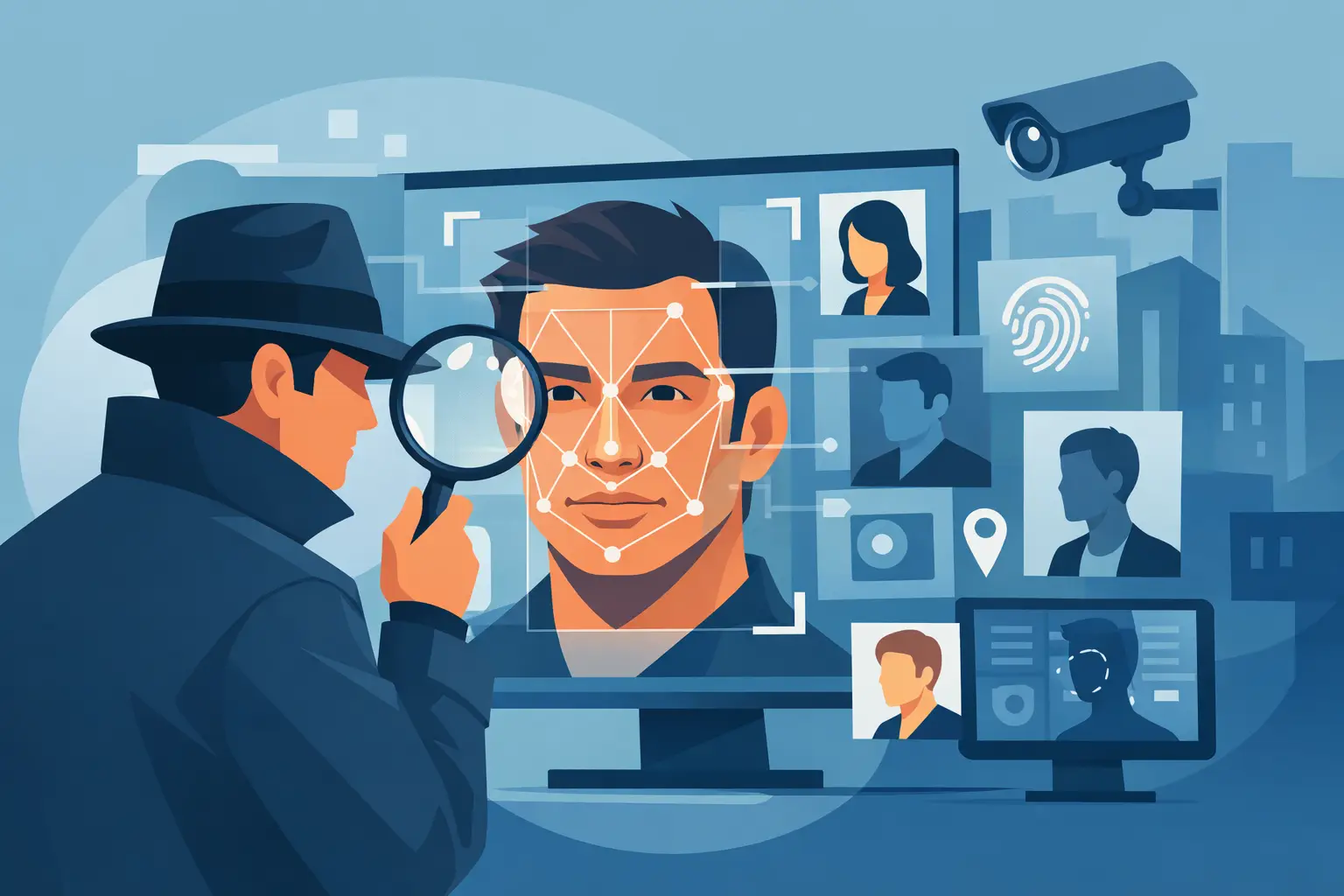
A blurry lobby frame at 11:14 p.m. is not a lead. It is a question. For a working investigator, private investigator face search only matters if it helps answer that question faster, with enough supporting detail to justify the next step.
That distinction matters because most face search discussions get stuck at the demo stage. A photo goes in, a possible name comes out, and the hard part gets skipped. In actual casework, the value is not the first hit. It is whether the result can be reviewed, cross-checked, documented, and escalated in a way that makes sense for the client, the incident, and the law.
What private investigator face search is really for
In professional investigations, face search is a triage tool first. It helps narrow uncertainty when you have a face photo, a screenshot, a social post, or a usable CCTV frame and need to know whether the person appears in permitted public sources.
That is very different from treating facial search like a shortcut to identity. A useful system returns confidence-scored signals, source context, and enough traceability for a human in the loop to decide whether the match deserves follow-up. If the tool cannot support review, it creates risk instead of clarity.
For private investigators, the strongest use cases are operational. You may be validating whether a trespass subject has an open public profile, checking whether an individual tied to repeat incidents appears across public-facing content, or trying to determine whether a person in surveillance footage is worth escalating to a property manager, legal team, or client contact. In each case, the question is not “Who is this, definitely?” The question is “What do we have, how strong is it, and what action is justified now?”
Why generic people-search tools fall short
Most consumer-oriented people-search products were not built for image-first investigations. They tend to assume you already have a name, phone number, or address. That is backwards for many field investigators, especially when the starting point is a still frame from a camera or a cropped image from a complaint file.
A private investigator face search workflow has different requirements. It needs to work from the image itself. It needs to handle imperfect source material, including off-angle faces, poor lighting, and compression artifacts. And it needs to preserve the line between a search signal and a verified finding.
Just as important, professional users need guardrails. If a platform blurs the line between lead generation and regulated decisioning, the risk lands on the investigator. That is why verification-first tools matter. They support public-interest workflows and evidence handling without pretending that a machine-generated match is a final answer.
What a defensible workflow looks like
A solid workflow is simple on paper: upload, review, verify, document, act. What separates a serious process from a risky one is discipline at each step.
Start with the best face image you can get
A bad crop wastes time. Before running a search, isolate the clearest frame available. Look for a forward-facing angle, visible eyes, and enough pixel detail to preserve facial structure. You do not need studio quality, but you do need a frame that gives the model something real to work with.
Investigators working from CCTV should avoid the temptation to over-edit. Basic cropping and frame selection help. Heavy sharpening, artificial enhancement, or aggressive filters can distort the source and make later review harder to defend.
Treat the first match as a signal, not a conclusion
This is where judgment earns its keep. A result with a high confidence score can still be wrong. A lower-confidence result can still be useful if the facial similarity is paired with matching context, such as geography, associated imagery, or profile consistency across sources.
A disciplined private investigator face search process looks at the face and the surrounding facts together. Does the apparent age range fit? Do tattoos, clothing cues, companions, or location hints line up with the incident? Are there multiple source appearances, or just one weak hit? Face similarity alone should never carry the whole case.
Preserve source traceability
If a match matters, save the context immediately. Investigators need source references, timestamps, screenshots, and an exportable record of what was reviewed. That is what turns a vague lead into something usable in an incident file or client update.
This is also where purpose-built platforms earn their place. Tools built for operational security workflows typically make it easier to package evidence, retain the search trail, and show why a lead was escalated. That matters when a property manager, attorney, or security director asks, “What exactly did you rely on?”
Where private investigator face search helps most
The strongest use cases tend to involve uncertainty under time pressure. A property team has recurring after-hours access issues but only partial camera coverage. A corporate security team is reviewing a person of interest seen near a restricted area. A private investigator receives a complaint tied to an image and needs to separate noise from something actionable.
In those situations, face search can shorten the path to context. It can reveal whether the person appears in public-facing material tied to an alias, a location, or a pattern of behavior worth further review. It can also help rule out dead ends quickly, which is just as valuable when caseloads are heavy.
There is a trade-off, though. The lower the image quality, the more careful you have to be about overconfidence. A side-profile convenience store still may produce no useful result, and that is not a system failure. Sometimes the right operational answer is to hold, gather more footage, and rerun the search when you have a better frame.
Compliance is not optional
Investigators already know that speed can create exposure. Face search adds another layer because it can feel more certain than it is. The safer approach is to use it inside a clear public-interest lane with a human in the loop and documented review.
That means understanding what the tool is for and what it is not for. An image-based search platform can help generate leads from permitted public sources, support incident triage, and package evidence for internal review or lawful escalation. It should not be treated like an automated decision-maker, and it should not be confused with a consumer reporting agency workflow.
For US-based teams, that distinction matters in practice. If a result may influence employment, housing, tenant screening, or another regulated decision, the legal standard changes. Professional users need systems and internal processes that respect that line rather than drifting across it because a match looked convincing.
What to look for in a face search platform
If you are evaluating a tool for investigations, focus less on flashy match claims and more on operational fit. Can it handle image-only starting points? Does it return source-linked results instead of black-box assertions? Can your team export a usable evidence package? Is there a clear compliance posture built into the product and its messaging?
It also helps to look for realistic support of CCTV-driven work. Many tools perform well on clean headshots and poorly on surveillance captures. That gap matters to investigators because real incidents rarely arrive as perfect portraits.
A platform such as SafetyCamAI is positioned around this verification-first model: upload a face photo or CCTV frame, review confidence-scored signals from permitted public sources, keep a human in the loop, and export the findings for escalation where appropriate. That framing is useful because it aligns the technology with actual investigative workflow instead of pretending software alone resolves identity.
The real standard is whether it helps you act responsibly
A good private investigator face search process does not just help you find possible matches. It helps you decide what deserves action, what needs more review, and what should be left alone.
That is the threshold professionals should care about. Fast signals are useful. Defensible signals are better. When face search is handled with discipline, it becomes a practical force multiplier for incident triage, identity verification, and case documentation. When it is handled casually, it creates noise and liability in equal measure.
The better question is not whether face search works. It is whether your workflow can turn a possible match into a responsible next step.