

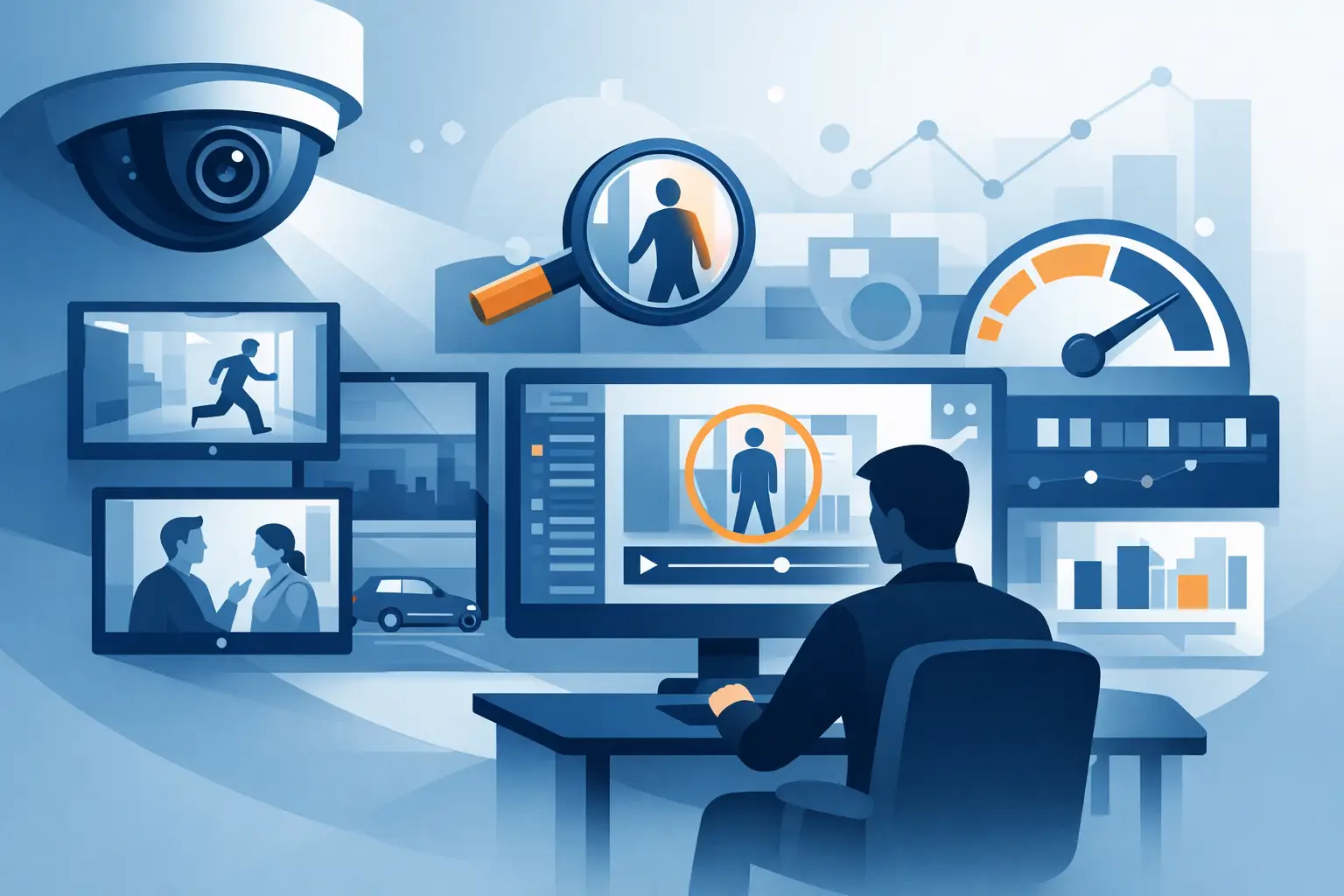
A blurry frame at 2:13 a.m. can burn an entire shift if your team has to scrub footage manually, guess at context, and still defend the outcome later. That is where cctv analytics earns its place. For security teams, investigators, and property operators, the real value is not flashy automation. It is faster triage, better verification, and cleaner documentation when something needs to move from suspicion to action.
What cctv analytics actually does
CCTV analytics is the use of software to detect patterns, objects, movement, faces, or behaviors inside surveillance footage so teams can review incidents with less manual effort. That sounds simple enough, but in practice the category is crowded with tools that promise more than they can support operationally.
Some analytics products focus on perimeter alerts, loitering, line crossing, occupancy, or vehicle counts. Others are built for investigation workflows, where the job is not just to notice activity but to verify who or what appears in a frame and package findings for escalation. Those are different use cases, and teams get into trouble when they buy for one and expect the other.
If you are reviewing incidents across apartments, parking lots, retail spaces, or corporate sites, speed matters. But defensibility matters just as much. A hit from an automated system is not a conclusion. It is a signal that needs review by a human in the loop.
Why cctv analytics matters in real operations
Most surveillance environments do not fail because cameras are missing. They fail because teams cannot turn footage into usable answers fast enough. A person tailgates through a side door. A package room theft happens between rounds. A trespasser appears across multiple cameras. By the time someone has reviewed enough clips to build a narrative, the window to respond has narrowed.
CCTV analytics reduces that lag in a few practical ways. It helps narrow footage to moments that matter, identify recurring appearances, and connect still frames to broader investigative context. For a property manager, that can mean resolving a resident complaint without tying up staff for hours. For a security team, it can mean distinguishing between a false alarm and a pattern worth immediate escalation.
The operational gain is not only time saved. It is consistency. Teams under pressure make uneven calls when every review starts from scratch. Analytics introduces a repeatable process: find the frame, test the signal, validate context, document what supports action, and leave a record that can withstand internal review.
The difference between alerts and verification
A lot of surveillance software is built around alerting. Motion triggers, unusual activity flags, person detection, and dwell-time notifications all have value. But alerting and verification are not the same thing.
An alert tells you something may have happened. Verification tells you whether the event, person, or pattern actually merits action. That gap is where many workflows break down. Teams drown in alerts because the software can detect movement but cannot help them establish identity, confirm recurrence, or support a handoff with evidence.
For professional users, especially in investigations and property operations, verification-first workflows are usually the better fit. If your team is regularly working from screenshots, exported frames, or phone captures of monitors, you need a process that starts with image evidence and ends with confidence-scored review, source validation, and exportable documentation. That is very different from simply wiring another alert into a dashboard.
Where cctv analytics delivers the most value
The strongest use cases share one trait: there is a clear operational decision on the other side of the footage. You are not analyzing video for its own sake. You are deciding whether to warn, trespass, escalate, report, or close the matter.
In multifamily and commercial properties, analytics is useful when repeated nuisance activity, package theft, unauthorized entry, or parking disputes generate constant review work. The footage exists, but the burden is proving what happened and whether the same person appears across incidents.
In corporate security, analytics helps when teams need to triage suspicious behavior quickly and document findings for legal, HR, or site leadership. In private investigations, it can shorten the time between receiving a still image and developing enough context to decide whether the lead is credible.
This is also why image-based workflows matter. Not every team can replace its camera stack or integrate every site into one system. Sometimes the fastest path is simpler: pull the best available frame, analyze it, compare it against permitted public-source signals, and decide what deserves a second look.
What to look for in a cctv analytics workflow
Accuracy matters, but accuracy alone is not enough. In real operations, teams need a workflow they can use under pressure without creating avoidable risk.
Start with input flexibility. Good analytics should work with imperfect evidence, including low-light frames, partial angles, monitor captures, and exports from older DVR systems. If a tool only performs well on ideal footage, it will disappoint in the field.
Next, look at how results are presented. Confidence scoring, source visibility, and an audit trail are not extras. They are part of responsible use. If a platform gives you a result without showing why it surfaced, your team is left defending a black box.
Then consider handoff. Can findings be exported with timestamps, source links, and enough structure to support internal reporting or escalation? If your team has to rebuild the evidence package manually every time, the time savings disappear.
Finally, examine boundaries. Any system touching identity-related review should make lawful use and role-based review clear. That means human validation, documented workflows, and plain language about what the tool is not meant to do. A platform built for professional review should be explicit about compliance guardrails and equally explicit that it is not a consumer reporting agency.
The trade-offs teams should understand
CCTV analytics is useful, but it is not magic. Video quality still sets the ceiling. A face turned away from camera, a hood in bad lighting, or aggressive compression can limit what any system can support. Better software helps, but it does not create evidence that was never captured.
There is also a trade-off between sensitivity and noise. If you tune analytics to catch everything, you may increase false positives. If you tune too tightly, you may miss relevant events. The right setting depends on the environment. A busy lobby, a quiet back lot, and a package room after hours should not all be treated the same.
Another trade-off is speed versus certainty. Early-stage triage often benefits from quick signal generation, especially when a threat or repeat trespass may be involved. But a fast signal should lead to review, not automatic action. Mature teams build that pause into the workflow.
A practical model: upload, match, review, act
The most effective analytics programs are easy to repeat. A workable model is simple: upload the best still frame or CCTV capture, run image-based matching or scene analysis, review confidence and source context, then export what supports action.
That is one reason platforms like SafetyCamAI fit operational users well. The approach is built around turning photos and CCTV frames into actionable safety signals, with human-in-the-loop review and evidence packaging designed for professional escalation workflows. For teams that do not want a heavy camera integration project, that model can be faster to deploy and easier to defend.
The discipline matters as much as the software. Save the frame with timestamp context. Record why the review started. Note what was matched, what was ruled out, and what still needs human confirmation. When an incident later gets questioned, that record becomes part of the value.
How to judge whether your current setup is working
If your team is still losing hours to manual scrubbing, missing repeat appearances across incidents, or sending around screenshots without a structured review trail, your setup is probably underpowered. The same is true if staff members are improvising with consumer tools that were not built for professional safety use cases.
A strong setup should help your team answer three questions quickly. What happened, who or what appears relevant, and what evidence supports the next step? If your current tools cannot support that chain without a lot of manual patchwork, the issue is not just efficiency. It is operational risk.
The better path is not always a full platform overhaul. Sometimes it is adding a verification layer that turns camera output into usable signals and exportable evidence. That is often enough to move from reactive review to a more disciplined incident workflow.
The best cctv analytics systems do not replace judgment. They give your team a faster, more defensible way to apply it when timing, accuracy, and lawful process all matter at once.
Responsible Use & Disclaimer: SafetyCamAI is a reverse-image / visual similarity search tool. It finds visually similar images from publicly accessible sources for informational purposes only. It does not identify individuals, verify identities, confirm criminal history, or provide arrest or background-check information. Results must not be used for employment, housing, credit, or any FCRA-covered purpose. Always use the app lawfully and ethically.