

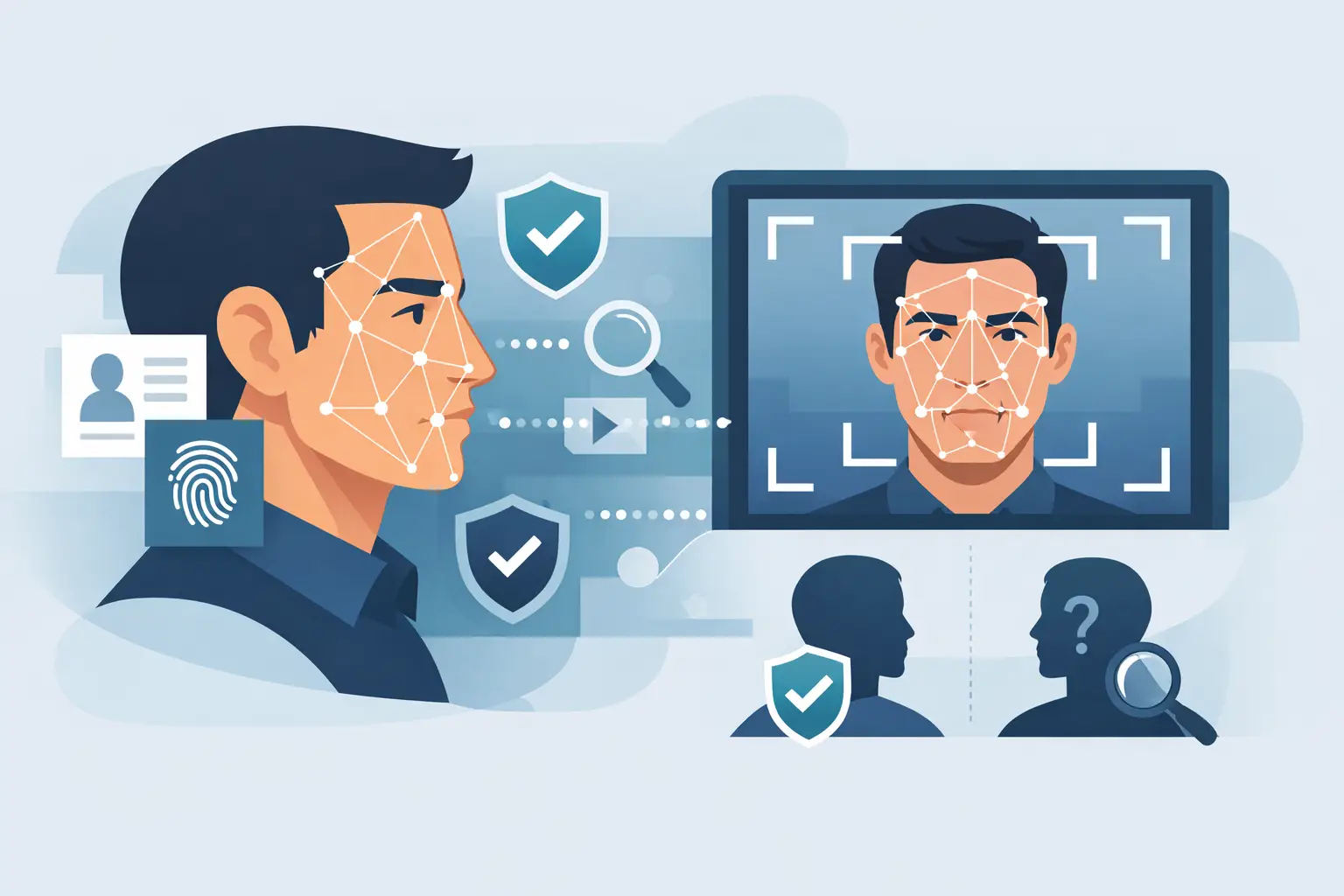
A face match becomes risky the moment someone treats it like proof instead of a signal. In real investigations, property incidents, and workplace safety reviews, what makes a face match defensible is not just a high score on a screen. It is the combination of image quality, source reliability, human review, documented reasoning, and a clear boundary between triage and final decision-making.
That distinction matters because most operational users are not trying to satisfy curiosity. They are trying to decide whether to escalate an incident, identify a recurring trespasser, verify whether a person of interest appears across public-facing sources, or package findings for internal review. If the match cannot withstand scrutiny from a supervisor, client, legal team, or law enforcement contact, it is not operationally useful.
What makes a face match defensible in practice
A defensible face match is one that another trained reviewer can understand, test, and challenge without the whole conclusion collapsing. It does not depend on a vague claim that the software said so. It rests on visible facts, recorded steps, and a workflow that keeps a human in the loop.
In practice, defensibility starts with a simple question: if you had to explain why this match was surfaced and why it was escalated, could you do it clearly using the image, the source material, and your review notes? If the answer is no, the match may still be interesting, but it is not ready for action.
That is why the strongest teams treat facial matching as a verification workflow, not an automated identity decision. The system produces leads. The reviewer examines whether those leads hold up.
The image itself sets the ceiling
A weak input image limits everything that follows. If the original CCTV frame is blurred, overcompressed, badly lit, partially blocked, or captured at a severe angle, the result may still return candidate matches, but the confidence you can place in those candidates is lower from the start.
The best input images show stable facial structure rather than momentary expression. Clear eye spacing, nose shape, brow line, jawline, ear visibility, and overall facial proportions matter more than a smile, beard growth, or hairstyle. Accessories and motion can easily mislead a reviewer if the underlying structure is not visible.
This is where operational discipline matters. A single low-quality frame may not be enough. Pulling several frames from the same sequence, selecting the clearest capture, and comparing more than one view can change a weak lead into a reviewable one. It can also expose a false positive early, before time gets wasted on escalation.
Source context matters as much as similarity
A match is more defensible when the source where it appears adds context instead of confusion. Similar-looking faces exist. What separates a plausible match from a defensible one is whether the surrounding source data aligns with the case you are working.
If a candidate image appears on a public profile, article, event page, or other public source, the reviewer should ask whether the age range, geography, time frame, and associated details make sense. A high visual resemblance tied to a source from the wrong state, the wrong decade, or a clearly inconsistent identity signal may not deserve escalation.
This is why source links and captured source evidence matter. A face match without traceable origin is hard to defend. A face match tied to reviewable public sources gives the investigator or security reviewer something concrete to assess. The image is only part of the story. The source is where the story either starts to hold together or falls apart.
Confidence scores help, but they do not decide
Confidence scoring is useful because it helps teams sort candidate matches quickly. It is not useful when people confuse ranking with certainty. A score can tell you that one result appears stronger than another based on the model’s analysis. It cannot tell you, by itself, that the person is conclusively identified.
A defensible workflow uses confidence scores as triage signals. Higher-scoring results may merit earlier review. Lower-scoring results may still matter if the source context is unusually strong. There is no universal cutoff that works across every image type, lighting condition, and operational use case.
That trade-off is especially relevant in CCTV-driven work. Surveillance imagery often contains poor lighting, side angles, compression artifacts, and partial occlusion. In those conditions, even a promising score should be treated carefully. The right response is not to trust the score less or more in the abstract. The right response is to review the score alongside image quality, facial consistency, and source context.
Human review is the control that makes the process credible
If no one can explain why a candidate looks right, the match is not defensible. Human review is what turns machine output into a professional assessment.
That review should focus on stable facial markers first and superficial features second. Hair can change. Glasses come off. Facial hair appears and disappears. Weight fluctuates. Even age progression can shift how a person presents in public images. Bone structure and relative feature placement tend to be more useful anchors.
A disciplined reviewer also looks for disconfirming evidence, not just supporting evidence. Does the ear shape fail to line up? Is the nose bridge materially different? Are the eyes set differently once angle distortion is accounted for? Defensibility gets stronger when the reviewer actively tries to disprove the match before deciding it is good enough to escalate.
For that reason, the best systems are built for a human-in-the-loop process. SafetyCamAI is positioned around that model because speed matters, but blind automation creates risk. In security and investigative workflows, credibility comes from reviewed signals, not machine-only claims.
Documentation is where defensibility becomes usable
A match may be visually persuasive and still fail operationally if nobody documents how it was reached. Documentation is what allows a supervisor, client, partner agency, or legal stakeholder to understand the basis for your escalation.
That record should show what image was submitted, when it was captured if known, what candidate sources were returned, which candidate was reviewed, what facial similarities were observed, what conflicts were considered, and why the matter was escalated or held back. Screenshots, timestamps, and source capture details turn a fleeting result into evidence that can be checked later.
This is also where audit-friendly packaging becomes more than a convenience. In a real case file, memory is not enough. Teams need an exportable record showing the review path, not just the end conclusion. If challenged, the reviewer should be able to show the work.
Lawful use and scope control are part of what makes a face match defensible
A face match can be technically strong and still be operationally indefensible if it is used outside lawful or appropriate boundaries. That is why compliance guardrails matter.
Professional users should stay in a public-interest lane tied to safety, investigation, verification, or incident response. They should also keep a clear line between generating investigative leads and making regulated eligibility decisions. That line matters because a tool designed for verification is not the same thing as a consumer reporting agency product.
Scope control also protects the quality of the work. When teams use facial matching to answer a narrow operational question – does this incident subject appear to match a public-source identity signal worth reviewing – they are more likely to document carefully and escalate appropriately. When they use it as a shortcut for broad assumptions, error risk rises fast.
When a face match is not defensible yet
Sometimes the right call is to stop. If the source image is too weak, if the candidate photos are too old or inconsistent, if context conflicts with the observed person, or if the reviewer cannot articulate clear facial correspondences, the match may not be defensible yet.
That does not mean the lead is useless. It may mean you need better frames, another source check, a second reviewer, or additional incident context before moving forward. Good teams know that restraint is part of sound escalation.
The real standard is not whether software found a similar face. It is whether your process produced a reviewed, documented, and explainable basis for action. When that standard is met, a face match becomes more than a fast signal. It becomes something your team can stand behind when the stakes are real.