

A low-light frame, a partial profile, and a match score can create false confidence fast. That is exactly why teams ask when should CCTV matches be escalated – not just whether a system returned a possible hit, but whether that hit is strong enough, relevant enough, and urgent enough to move into action.
For security teams, investigators, and property operators, escalation is not the same as identification. A CCTV match is a signal. Escalation is a workflow decision. The gap between those two matters because moving too slowly can expose people and property to risk, while moving too quickly on weak evidence can create compliance problems, bad reporting, and avoidable mistakes.
When should CCTV matches be escalated in practice?
The short answer is this: escalate when the match is material to a real safety, investigative, or operational decision and has enough supporting context to justify human review beyond the first triage pass.
That means score alone is not enough. A high-confidence result from a poor frame can still be weak if the face is obstructed, the angle is extreme, or the source context does not line up. On the other hand, a moderate-confidence result may deserve immediate escalation if the incident involves trespass, stalking, violence, theft patterns, or a person returning to a site after a prior documented event.
A useful standard is whether the match changes what your team does next. If the result could affect incident handling, site access decisions, internal case priority, or a handoff to counsel or law enforcement, it should not stay in an informal notes pile. It should be escalated into a reviewed, documented workflow.
Match confidence matters, but context decides
A disciplined workflow treats confidence scoring as one input, not a verdict. Strong scores become more meaningful when the image quality is acceptable and the source material is recent, consistent, and relevant to the incident. Weak or mixed source context should slow the process down, even if the score looks persuasive.
Start with frame quality. If the CCTV image shows a clear frontal or near-frontal face, usable lighting, and enough facial detail for comparison, a match has more operational value. If the frame is blurred, captured from above, partially blocked by a hood, or taken from a side angle, the threshold for escalation should be higher. Human in the loop review is not optional here. It is the control that keeps a promising lead from turning into a bad assumption.
Then look at source consistency. Do multiple public-source signals point toward the same person? Do the face photos appear temporally and visually consistent with the subject in your frame? Does the surrounding context support relevance, such as geographic ties, known aliases, or associated activity that fits the incident timeline? The more those elements align, the stronger the case for escalation.
The incidents that usually justify faster escalation
Not every unknown-person event needs the same response window. Escalation should speed up when the operational stakes are high.
Cases involving threats, assault, stalking, repeat trespass, organized theft, forced entry, or attempted access to restricted areas usually justify immediate review by a supervisor or designated investigator. The same is true when a subject appears across multiple cameras, multiple dates, or multiple properties. Pattern repetition often matters more than a single isolated image because it changes the risk posture from curiosity to active concern.
Property teams should also treat resident-facing incidents differently from routine nuisance activity. If a possible match relates to harassment, domestic violence concerns, package theft rings, or a person previously warned off the premises, escalation is often warranted even before identity is fully validated. The goal is not to label someone prematurely. The goal is to route the case into a controlled review path before risk compounds.
Corporate security and investigators will often have another trigger: whether the match affects a current case file. If a returned signal connects to an open fraud review, workplace violence concern, executive protection issue, or internal misconduct investigation, the threshold for escalation drops because the case context already exists.
When should CCTV matches be escalated to a supervisor or case lead?
Escalate upward when the reviewer cannot resolve material uncertainty alone. That includes situations where the match score is notable but the imagery is weak, where several candidate identities are plausible, or where the source context creates legal or reputational sensitivity.
Supervisor review is also appropriate when any proposed action would affect a person directly, such as exclusion from property, formal incident attribution, or a referral to outside parties. A front-line analyst can triage and validate signals, but decisions with downstream consequences should sit with someone who can weigh policy, evidence sufficiency, and lawful-use boundaries together.
This is where audit-ready documentation becomes essential. The escalation package should include the original CCTV frame, any enhanced or alternate frames used for comparison, the returned match signals, timestamps, source references, analyst notes, and a clear statement of what is known versus inferred. Clean documentation protects the team as much as it supports the case.
Signs a match should not be escalated yet
Sometimes the right move is to pause. If the face is too obscured for reliable comparison, if only one weak public-source signal appears, or if the apparent match depends on non-facial assumptions like clothing or build, escalation may be premature.
The same caution applies when the incident itself is low consequence and there is no repeat pattern. An unknown person lingering once near a parking area may justify monitoring and evidence retention, not immediate case escalation. Teams get into trouble when every possible hit is treated as a solved identification event.
Another stop sign is mismatch between source context and incident facts. If the returned candidate appears tied to a different age range, geography, or time period than the subject in question, do not force the fit. A verification-first workflow is built to reject weak matches quickly, not rationalize them.
Build an escalation threshold before the next incident
The best time to decide when should CCTV matches be escalated is before your queue fills up. Teams need a written threshold that combines image quality, confidence bands, incident severity, repeat appearance, and intended downstream use.
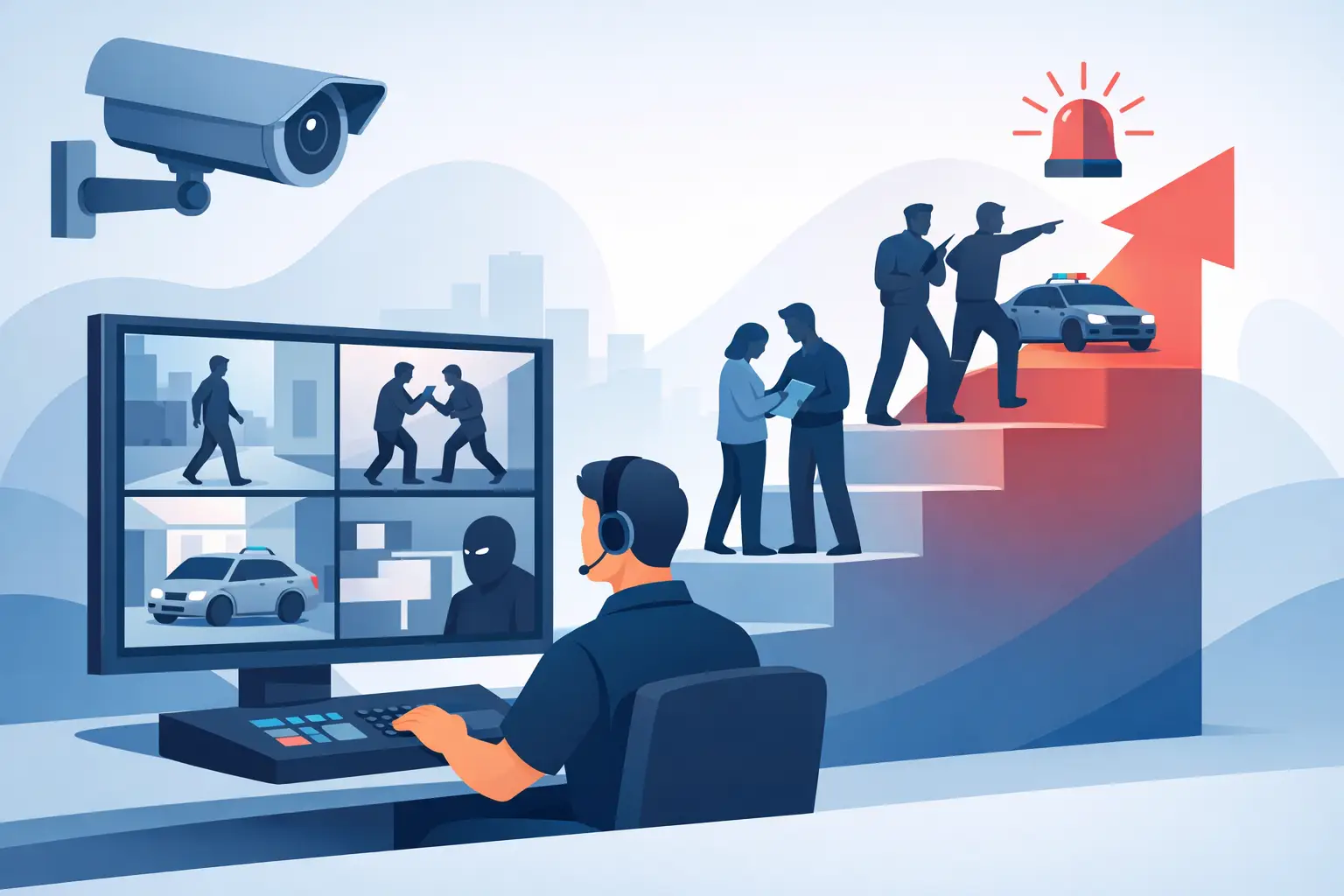
In practice, that usually means creating three lanes. The first is monitor only – weak or low-consequence signals that stay in observation. The second is analyst review – credible signals that need more comparison, a better frame, or corroborating context. The third is formal escalation – matches tied to immediate risk, repeat incidents, or actions that require supervisory approval and evidence packaging.
That structure creates consistency across shifts and sites. It also helps defend why one case moved fast while another stayed in review. Consistency is not bureaucracy for its own sake. It is what keeps urgency from becoming improvisation.
A platform like SafetyCamAI fits this workflow best when used as a verification tool, not an autopilot. Upload the clearest frame available, review confidence-scored signals, compare the public-source context, and export the evidence package when the case crosses your internal threshold. Fast signals are valuable. Defensible signals are what hold up under pressure.
Escalation should match the decision, not the technology
A common mistake is treating advanced matching output as the reason to escalate. It is not. The reason to escalate is that the result, combined with incident facts, may justify a new protective or investigative step.
That distinction matters for compliance. Image-based matching can support lawful safety and verification workflows, but it should stay in its lane. It is not a substitute for formal identification processes, and it should not be used as a consumer reporting function. The stronger your process is on review, documentation, and role-based decision making, the more useful the technology becomes.
If your team remembers one rule, make it this: escalate CCTV matches when they are relevant, sufficiently supported, and tied to a real decision that deserves documented human review. Anything less is noise. Anything more belongs in a case file, not a guess.
Good security work is rarely about moving fastest. It is about knowing when speed helps and when discipline protects the outcome.