

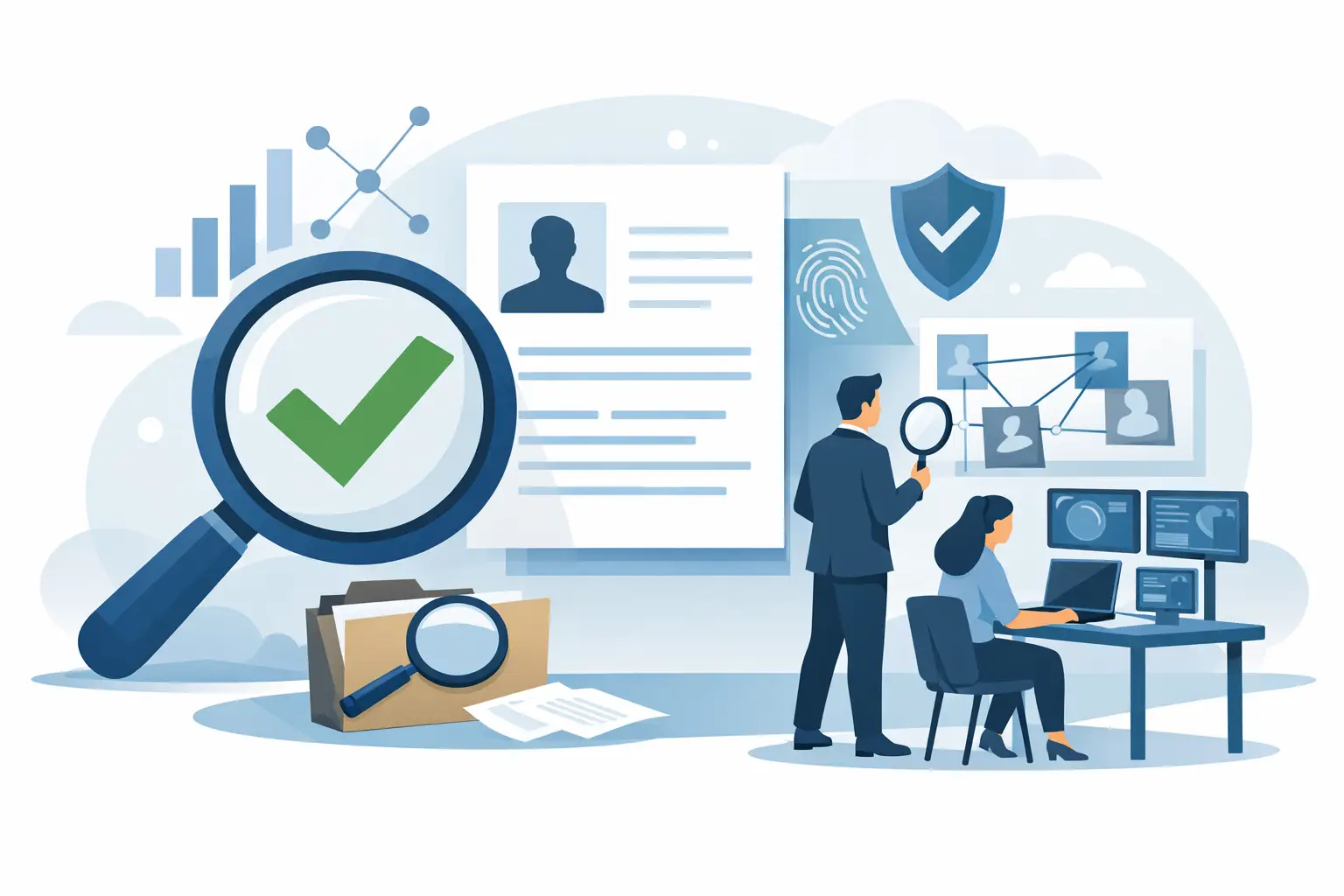
A blurry lobby frame at 11:42 p.m. is not a case closed. It is a starting point. In professional security work, verification first investigations matter because the pressure to identify someone quickly is real, but the cost of being wrong is usually higher than the cost of taking one more review step.
That is the gap many teams still struggle with. They have images, incident reports, and a need to act, but they do not always have a workflow built around validating what the image actually supports. A verification-first approach fixes that. It treats facial match signals, source material, and investigator review as parts of one disciplined process rather than one-click certainty.
What verification first investigations actually mean
Verification first investigations start from a simple rule: no match result should stand on its own. An image-based lead can be useful, fast, and highly relevant, but it still needs review in context. That means checking source links, comparing facial features across images, assessing image quality, and documenting why a result is credible enough to escalate.
For security teams, investigators, and property managers, this is not academic. It changes how incidents get triaged. Instead of asking, “Did the tool find someone?” the better question is, “Did the tool produce a signal we can verify and defend?” That shift matters when the image comes from a low-angle camera, poor lighting, motion blur, or a partial face.
A verification-first workflow also creates a cleaner line between investigation support and prohibited use. That is especially important for teams that need to move fast while staying inside compliance guardrails. Human in the loop review is not a delay tactic. It is the control that keeps urgency from turning into overreach.
Why speed without verification creates risk
Fast answers are useful only when they improve decisions. In incident review, speed by itself can create false confidence. A promising visual match may be based on a weak frame, outdated source imagery, or a resemblance that looks stronger at first glance than it does under side-by-side review.
That risk shows up in practical ways. A property manager may escalate the wrong trespass pattern. A security team may spend time on a person who is visually similar but unrelated to the event. An investigator may package findings that are difficult to defend later because the path from image to conclusion was never clearly documented.
Verification reduces these failures by forcing a pause at the right moment. Not a long pause. Just enough to confirm whether the signal deserves action. In a strong workflow, the system helps surface likely matches, but a trained user reviews confidence, image quality, source context, and incident relevance before moving forward.
This is why generic people-search habits often break down in professional safety settings. Those tools are usually built around broad identity lookup, not CCTV-driven triage. They can encourage a search-first mindset instead of an evidence-first one. Verification first investigations work better because they start with the image, stay tied to the incident, and require validation before escalation.
A practical verification-first workflow
The best operational model is simple enough to use under pressure. It starts with the clearest available face image, even if that means pulling multiple frames from CCTV and selecting the least distorted option. If the face is partially turned, blocked, or blurred, that should shape expectations immediately. Not every frame can support a reliable lead.
From there, the goal is to generate match signals from permitted public sources and review them in context. This is where confidence scoring helps, but only if teams treat it as one input rather than the decision itself. A high-confidence signal on a poor source image can still be weak. A moderate-confidence signal with strong visual alignment across several images can sometimes be more useful.
Verification first investigations in the real world
In practice, review usually comes down to four questions. Does the face in the candidate image align on stable features such as eye spacing, nose shape, jawline, ear structure, and hairline when visible? Does the source material appear current enough to be relevant? Does the candidate fit the known incident context, including location, timing, and behavior? And can the team explain the reasoning clearly if the finding is handed off internally or to counsel or law enforcement?
If the answer to those questions is mixed, the right move may be to hold the result as a lead rather than an identification. That distinction protects both the investigation and the people involved. Good teams do not inflate confidence to sound decisive. They separate strong verification from tentative similarity.
When the signal does hold up, documentation becomes the next control point. Exportable evidence packaging is not just an administrative feature. It is part of the investigative standard. Teams should preserve the searched image, candidate sources, timestamps, review notes, and the rationale for escalation. That record matters later if someone asks why a case moved from triage to action.
Why image-only workflows fit security operations better
Many safety and risk teams are not trying to build full identity profiles. They are trying to answer a narrower and more urgent question: does this person in our image connect to publicly available visual evidence that supports further review? That is a very different task from consumer people-search.
An image-only workflow is often better suited to that task because it keeps the process anchored to what the incident actually provides. The input is a face photo or CCTV frame. The output is a confidence-scored set of visual leads with source material for human review. That is operationally cleaner than broad searches that invite irrelevant data, excess assumptions, or unsupported conclusions.
For apartment operators, retail security teams, and investigators handling recurring incidents, that focus can save time. It reduces the drift that happens when searches expand beyond the incident itself. It also aligns better with compliance-conscious use, because the workflow is organized around verification and escalation rather than consumer-style profiling.
SafetyCamAI is built around that public-interest lane: image-only, human in the loop, and structured for verification workflows rather than consumer reporting.
Where verification-first work still has limits
A serious workflow has to acknowledge what the technology cannot settle. Poor source material remains the biggest constraint. If the face is heavily obscured, too small in frame, or distorted by angle, the output may be inconclusive no matter how good the search process is. Teams need to recognize that early instead of forcing a result.
There is also a limit to what a public-source visual match can prove. It can generate a credible lead. It can support triage. It can strengthen a pattern when combined with incident facts and repeat appearances. But depending on the situation, it may still require additional corroboration before any major decision is made.
This is where experienced teams separate operational confidence from overstatement. They know that a match signal is useful because it narrows attention and speeds review, not because it replaces judgment. The more serious the consequence, the stronger the verification standard should be.
Building a defensible process across teams
Verification-first work gets stronger when it is repeatable. That means setting internal rules for image selection, confidence thresholds, second-review triggers, and evidence retention. A one-person shortcut may feel efficient, but it becomes a problem when another reviewer cannot reconstruct what happened.
Cross-functional teams should also agree on language. “Possible match,” “verified lead,” and “ready for escalation” should not mean different things to security, operations, and management. Consistent labels reduce confusion and make handoffs cleaner.
The strongest programs also train people to reject weak results without treating that as failure. Sometimes the right answer is that the image does not support identification. That is not wasted effort. It is disciplined screening. A system that helps teams rule out bad leads quickly is just as valuable as one that surfaces good ones.
Verification first investigations win because they respect the real conditions of safety work. Images are imperfect. Incidents are time-sensitive. Decisions have consequences. The right workflow does not promise certainty from a single frame – it helps professionals move from image to signal to reviewed evidence with control. That is how you verify people faster without lowering the standard for action.