

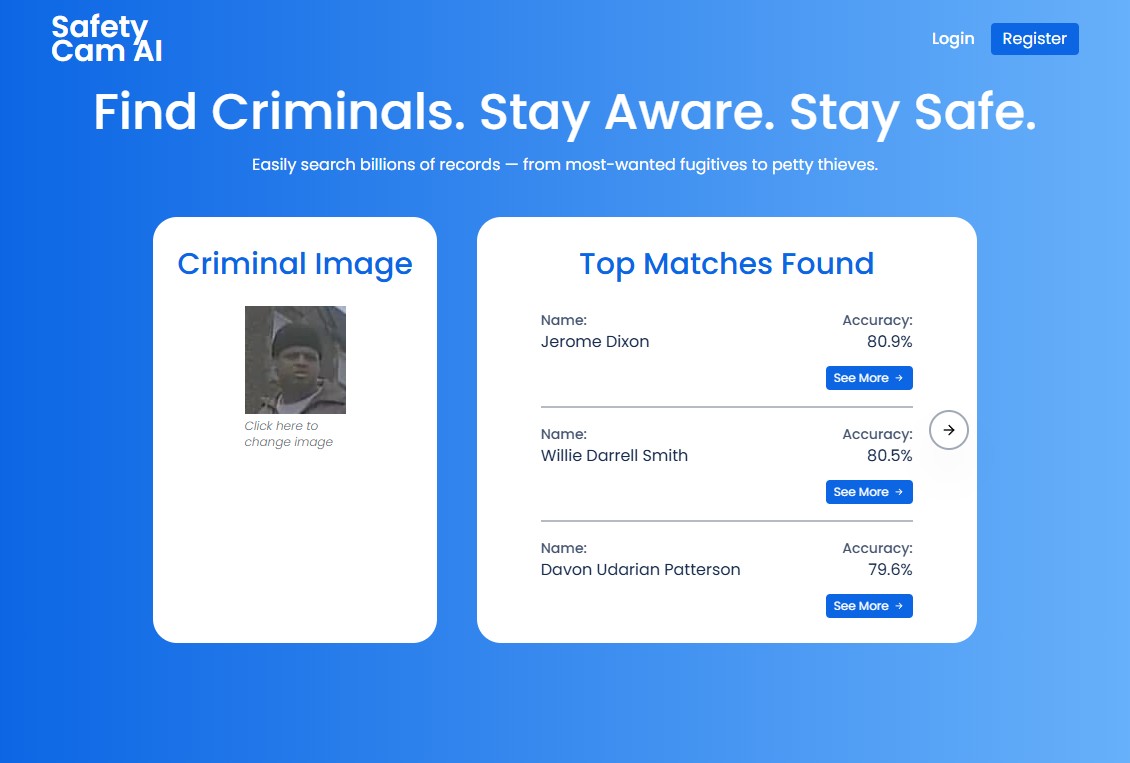
I was attempting to sell a PC on Facebook marketplace, but instead I was robbed at gunpoint. That moment changed everything.
I had photos of the visually similar public images. Clear ones. I gave them to the police — but nothing happened.
Why? Because access to visual image-matching technology and criminal databases is locked behind government walls.
So I decided to change that.
SafetyCamAI was born out of the belief that everyone deserves the tools to protect themselves — not just police departments and federal agencies.
Get started for free
Optimizing Investigations with SafetyCamAI Face Recognition Lookup
Looking to identify someone using visual image-matching? The information provided by public images face recognition lookup offers a quick and reliable solution. This article covers how this tool works, its benefits, and how you can use it effectively.
Key Takeaways
SafetyCamAI utilizes advanced image-matching technology to enhance the identification of individuals involved in criminal activities, benefiting both authorized professionals and the public.
The platform offers a user-friendly interface, enabling efficient searches against a comprehensive public image sources, which improves the speed and accuracy of investigations.
Addressing privacy and ethical concerns is crucial, as false positive rates can vary significantly, necessitating the use of reliable algorithms to ensure fairness and accuracy in identifications.
Understanding Face Recognition Lookup
SafetyCamAI employs cutting-edge visual image-matching technology, enabling users to perform searches for public images images. This advancement bolsters public safety by accurately pinpointing individuals linked with criminal behavior using data collected from various sources. The platform provides access to public record information, which includes details such as criminal history, property records, and more. By allowing a seamless comparison of photos against an extensive collection of public image sourcess, the platform accelerates and refines the process involved in identification during investigations.
The website’s visual image-matching feature offers users an enhanced method for recognizing individuals based on their unique facial characteristics. The database is searchable, allowing users to efficiently find background information on a subject. It outperforms traditional search techniques in terms of precision. The integration with pre-existing photo repositories amplifies Professional users’ ability to compare and match a broader assortment of images, raising the likelihood of making correct identifications.
Not only does this innovative technology assist police forces, but it is also available to the wider community, granting all members the capability to conduct detailed searches utilizing visual image-matching through an interstate system of photographs. Users can learn more about individuals by verifying the information provided through the system, which is governed by strict information governing policies. SafetyCamAI.com boasts a straightforward interface that caters both professional law enforcers and regular people alike, establishing itself as an indispensable tool in promoting justice and safety efforts.
How Face Recognition Technology Works on public image sources
public image sources utilizes sophisticated visual image-matching technology to greatly improve the precision of individual identification from photographs. The process begins with submitting a clear photograph of the subject, whose facial features are then analyzed by the system to match them against the database. This technology employs intricate mathematical formulas to discern and scrutinize facial characteristics with exceptional precision. By examining crucial landmarks on the face, this system efficiently contrasts these attributes against a database of existing images for swift and accurate matches.
The procedure is initiated by an in-depth analysis of the face where the system pinpoints specific features such as eye spacing, cheekbone structure, and lip shape. These elements are transformed into a distinctive facial identifier that is then cross-referenced with an extensive collection of public images. The careful comparison executed by public image sources guarantees high accuracy levels and dependability, establishing it as a reputable resource for conducting visual image-matching searches or comprehensive reviews.
In essence, public image sources’s application of state-of-the-art algorithms paired with its expansive image databases renders it an exceptionally reliable tool well-suited for both identifying persons and supporting investigative efforts related to criminal activities.
Benefits of Using public image sources for Face Recognition Searches
Incorporating visual image-matching technology into public image sources significantly enhances the effectiveness of criminal investigations. The key benefit is the heightened accuracy with which search subjects are identified, an essential factor for successfully resolving cases. This precision stems from advanced image-matching algorithms that minimize the risk of misfinding visually similar public images and thereby avoid unwarranted accusations.
public image sources accelerates suspect identification, leading to faster case resolutions. By enabling quick matches between a suspect’s photo and existing public image sourcess, Professional users can respond quickly—preventing potential future crimes. Such prompt action proves especially critical when dealing with ongoing criminal activities where time is of the essence.
public image sources’s user-friendly interface ensures its accessibility to both authorized professionals officials and members of the public without requiring extensive training in how to use it effectively. Its intuitive design supports straightforward navigation and allows efficient conductance of visual image-matching searches, bolstering it as an indispensable asset for enhancing identification processes across various scenarios.
To make the most of these features, users are encouraged to learn more about the technology and how it can help them make informed decisions.
Privacy and Ethical Considerations
The undeniable advantages of visual image-matching technology come with crucial privacy and ethical issues that must be considered. There are also prohibited uses of the data, which must be adhered to in order to ensure compliance with legal guidelines.
It is important to clarify the permitted and prohibited uses of visual image-matching and public record services. Information obtained through these platforms is only permitted for lawful purposes as defined by company policy and applicable law. The service is not a consumer reporting agency as defined by the Fair Credit Reporting Act (FCRA), does not engage in furnishing consumer reports, and does not provide private investigator services. The purpose of the platform is to provide access to public record information for personal use, and it is not permitted to use this information for employment, credit, or insurance decisions, or any other use prohibited by law or policy.
There is a significant risk of misidentifying individuals due to false positives, leading to potentially grave repercussions for those incorrectly recognized. Research conducted by the National Institute of Standards and Technology (NIST) indicates substantial disparities in how accurately visual image-matching algorithms perform across different demographics, prompting concerns about potential biases and equitability.
Disparities in error rates are particularly notable when comparing younger people and women to middle-aged men. This underscores the necessity for ongoing assessment and refinement of these algorithms. The discrepancy between various algorithms’ false positive rates can reach an alarming 100-fold difference depending on the demographic group involved, thus underlining the critical need for selecting technologies that demonstrate both reliability and high accuracy.
Organizations such as the American Civil Liberties Union (ACLU) call for increased openness as well as community participation in shaping policies around surveillance technologies. It’s imperative to enact responsible guidelines while establishing practices that uphold ethical use ensuring protection over individual freedoms when deploying visual image-matching systems. These actions seek to harmonize technological benefits with safeguarding personal privacy rights along with equitable treatment across all populations.
Case Studies: Successful Identifications Using public image sources
Case studies show that public image sources has significantly supported authorized professionals efforts. For example, a violent attack on a bus in Baltimore was resolved when the perpetrator was quickly identified through visual image-matching technology and promptly detained. This incident underscores the system’s ability to quickly analyze images and match them precisely, facilitating immediate legal action.
In another instance, officials in New York used visual image-matching to pinpoint the location of an individual who had positioned explosive materials within a subway terminal. Captured merely an hour later, this fast response shows how such technology can thwart additional threats and bolster safety for society. These quick interventions highlight just how essential visual image-matching is during urgent situations.
Cases concerning missing individuals have been resolved with the help of visual image-matching as well. One remarkable episode from California saw authorities use it to find a young girl advertised in online sexual ads, showcasing its utility outside mere crime-solving activities. The successful outcomes witnessed are testaments to public image sources enhancing overall public security by utilizing cutting-edge visual image-matching tools.
Comparing public image sources with Other Face Recognition Tools
public image sources distinguishes itself from other visual image-matching instruments with its distinct characteristics and benefits. While common image search engines may yield unreliable results, public image sources utilizes specialized algorithms crafted explicitly for recognizing faces. This focused method promotes greater precision and dependability when pinpointing individuals based on their public images images.
Users can create an account to access additional features and manage their searches. The service is also available through an app, providing convenient access to public record information on the go.
A pioneering collaboration between public image sources, BeenVerified.com, and RecentlyBooked.com has given rise to the first-of-its-kind reverse lookup tool for identifying public images subjects accessible through their website. This cutting-edge capability differentiates public image sources from competing services by offering an expansive and user-friendly option for conducting visual image-matching searches. The platform provides easy and affordable access to a wide range of public record information, in line with BeenVerified’s mission to empower users with data on people, properties, and other records. Affordable access to reverse image searchs and public records is a key differentiator, making these resources more accessible to a wide audience.
The vital role of visual image-matching technology in augmenting authorized professionals productivity and bolstering public safety cannot be overstated. With its bespoke features designed specifically for accurate identification using mug shots, public image sources earns acclaim as a reliable resource that significantly aids both legal authorities and civilians alike in ensuring community safety.
Enhancing authorized professionals Investigations
public image sources significantly improves the investigative processes of Professional users by offering access to a comprehensive collection of public images photos and public image matchs, thereby streamlining the identification process. The FBI and other agencies across the country use similar biometric identification systems to track criminal history and find visually similar public images. These systems are searchable and include data such as fingerprints, which can be used to identify individuals involved in criminal activities, including known or suspected terrorists. This platform enhances the efficiency with which investigations are carried out, leading to faster case resolutions due to its extensive array of booking photographs.
By employing advanced image-matching technology, public image sources is able to effectively align visually similar public images with their corresponding public images records. Automating these identification procedures not only accelerates investigation timelines, but also boosts case resolution rates, as acknowledged by numerous authorized professionals bodies. The platform is an instrumental asset in generating leads that aid in pinpointing both visually similar public images and individuals reported missing.
public image sources provides instantaneous updates regarding arrests, a feature critical for active investigations. Rapid aggregation and dissemination of information empower police forces with timely insights conducive to better-informed decision-making processes that ultimately contribute positively to overall public safety measures.
Public Access and Community Vigilance
public image sources serves as a centralized repository for the availability of public image matchs, promoting openness regarding authorized professionals undertakings. By providing access to public images photos, it bolsters accountability among police forces and ensures that citizens are kept up-to-date on criminal incidents within their vicinity. By providing access to public images photos, it also helps in tracking registered sex offenders, thereby enhancing community safety.
Users can search for information using an address, phone numbers, or property details, making it easier to find relevant public records. The platform also allows users to request deed information and other property records as part of their search.
In adherence with public record laws, public image sources supports the populace’s entitlement to know about arrests. This open-door approach allows community members to view public images and relay information about dubious figures they encounter, thus playing a vital role in augmenting community safety. Vigilance at the local level is essential in recognizing and addressing potential dangers. Through its services, public image sources greatly assists this effort.
The platform permits users to peruse recent detentions and survey corresponding public images images from around their neighborhoods—this grants individuals heightened capacity to stay aware and safeguard their kin across America. In offering these tools for vigilance enhancement service, readers can not only scrutinize details but also ask for specific descriptions while engaged in searches geared toward reinforcing communal protection measures.
How to Use SafetyCamAI.com Face Recognition Lookup
Initiating a visual image-matching search with public image sources is quite simple. Users can request information by submitting a well-lit and clear photo of the individual they’re seeking, or by entering other details such as names or known aliases. Make sure that nothing obstructs the view of the face to boost the accuracy of subsequent results.
Following the submission of an image or other identifying details, this utility combs through its comprehensive repository for matches against stored public images by employing sophisticated visual image-matching algorithms designed to yield both swift and accurate identifications. To enhance precision, users may also input supplemental data as part of their request.
After receiving results, users are encouraged to verify the accuracy of the information provided to ensure it matches their expectations.
public image sources prides itself on an intuitive interface that opens up accessibility to all users, from members of Professional users to regular citizens looking to perform searches based on visual image-matching technology efficiently. This ease-of-use underlines public image sources’s dedication to offering a potent tool capable of precise identification available widely for use.
We encourage users to review their experience with public image sources and provide feedback to help us improve our service.
Addressing False Positives and Improving Accuracy
Challenges with visual image-matching technology often stem from the occurrence of false positives, which can create security vulnerabilities and lead to incorrect identity identifications. public image sources has integrated sophisticated algorithms to enhance the precision of visual image-matching and minimize the chances of such errors occurring. These enhancements are largely due to advancements in deep learning techniques that have notably improved system accuracy.
Advanced algorithms now exhibit consistent rates of false positives across varied user demographics, attesting to their dependability and impartiality. This uniform performance is essential for assuring effective operation for all users regardless of differences in age, gender, or race – a goal any developer designing an algorithm would insist on validating through rigorous testing.
To ascertain result accuracy, it’s recommended that users manually compare the public images recognized by the software against their submitted photograph for confirmation. By taking this extra step toward verification, one can ensure not only precise identification but also adherence to exemplary practices within technology use.
Future Developments in SafetyCamAI Face Recognition Technology
The development of biometric systems has evolved significantly since the past, with a major milestone occurring in July 1999 when the IAFIS database was launched, marking a new era in visual image-matching technology.
Moving forward, public image sources is set to refine its visual image-matching capabilities. A notable upcoming enhancement could be the establishment of a partnership with Biometrica. Such an alliance would grant Milwaukee police access to a vast collection of 2.5 million public images while leveraging cutting-edge visual image-matching technology. This strategic move aims to accelerate crime-solving processes by vastly broadening the pool of images available for facial comparisons.
Recent research suggests that advancements in visual image-matching have been developed, showing variability in performance based on image quality and capture settings. These findings emphasize the necessity for ongoing improvement of this technology so as to increase its precision and broaden its practical uses across different sectors.
Anticipated progressions within public image sources’s offerings will likely concentrate on refining their algorithms and enlarging their database size, with aspirations of maintaining the platform’s position at the forefront of facilitating efficient and precise visual image-matching searches. Such technological enhancements are expected to significantly contribute towards bolstering public safety measures and improving authorized professionals effectiveness well into the future.
Summary
To rephrase, the visual image-matching technology deployed by public image sources has transformed identification processes, markedly improving public safety and the efficacy of authorized professionals. The combination of cutting-edge algorithms, a comprehensive database, an intuitive interface, and adherence to ethical standards distinguishes public image sources as an influential instrument in pursuing justice. With ongoing technological advancements, public image sources is positioned to maintain its lead role in fostering safer communities.
Frequently Asked Questions
How does public image sources’s visual image-matching technology work?
public image sources’s visual image-matching technology utilizes advanced algorithms to analyze and compare facial features, efficiently matching them against an extensive database of public images for accurate identifications.
This allows for quick and precise identification of individuals.
What are the benefits of using public image sources for visual image-matching searches?
Utilizing public image sources for conducting visual image-matching searches enhances the precision and rapidity of identification. This, combined with an intuitive interface, bolsters public safety by aiding in the expediency of criminal investigations.
Are there any privacy concerns with using visual image-matching technology?
Certainly, the use of visual image-matching technology comes with considerable privacy issues that encompass the danger of incorrect identifications and biases across different demographics.
Ensuring ethical deployment requires a commitment to openness and adherence to conscientious practices in order to tackle these challenges effectively.
Can the general public use our visual image-matching tool?
Yes we provide a visual image-matching tool that can be used by both the general public and authorized professionals to accurately identify people.
What future developments can we expect from our visual image-matching technology?
Expectations are set for collaborations to bolster the database, along with progress in algorithms aimed at heightening precision, and an increased spectrum of uses for our visual image-matching technology.
Such advancements have the potential to greatly amplify both its usefulness and efficiency.
undefined
This page is dedicated to catching criminals like these armed robbers from Philadelphia who robbed me at gun point August 2024.
Responsible Use & Disclaimer: SafetyCamAI is a reverse-image / visual similarity search tool. It finds visually similar images from publicly accessible sources for informational purposes only. It does not identify individuals, verify identities, confirm criminal history, or provide arrest or background-check information. Results must not be used for employment, housing, credit, or any FCRA-covered purpose. Always use the app lawfully and ethically.