

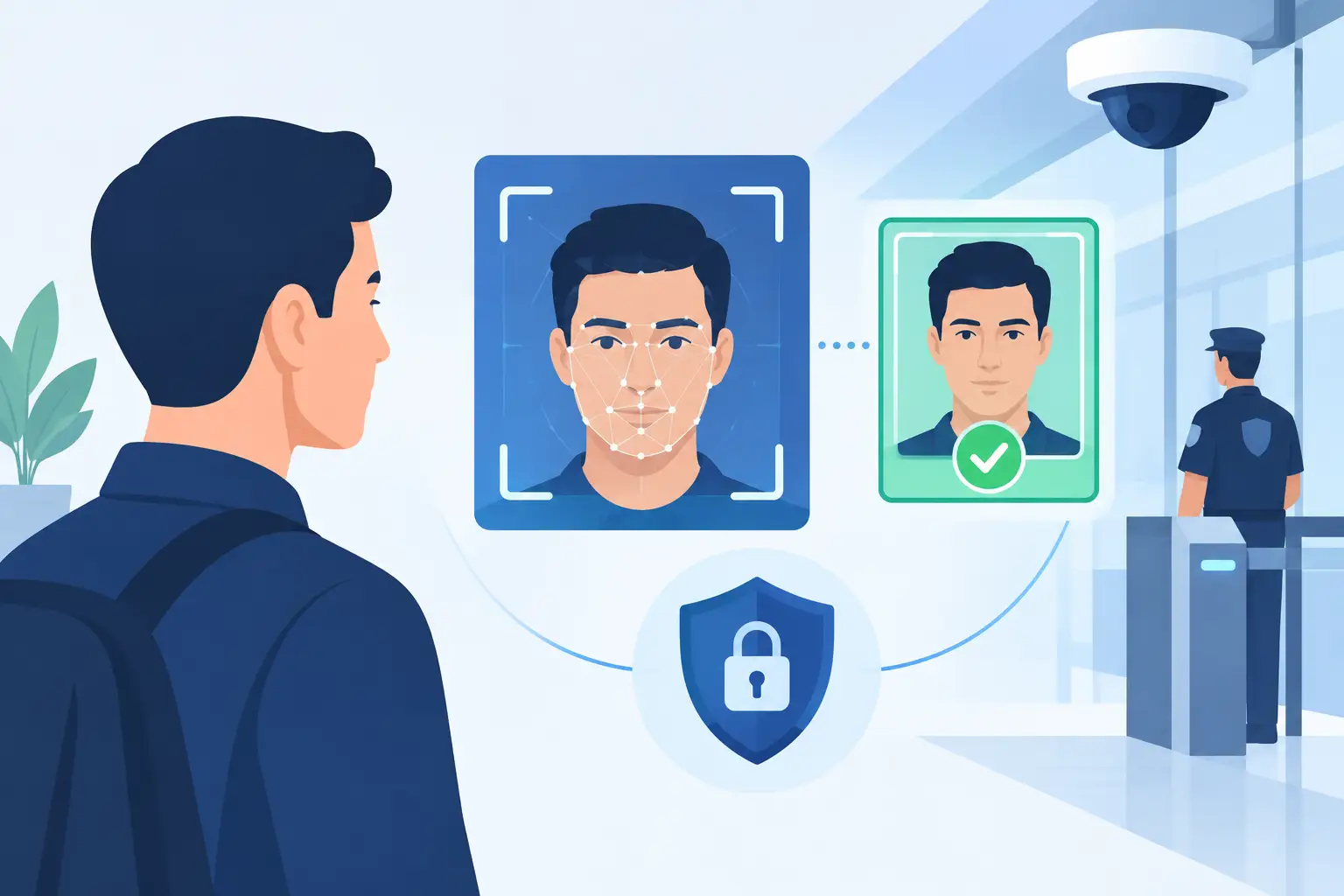
A grainy CCTV frame rarely arrives with a name, a timeline, or enough context to justify immediate escalation. It arrives after an incident, during a tenant complaint, or in the middle of an investigation when the team needs to decide what matters next. A facial matching API helps turn that image into a faster verification workflow – but only when it is used as a signal-generation tool, not an automatic decision-maker.
For security teams, investigators, and property operators, the value is not simply finding a possible match. The value is receiving confidence-scored results, reviewing the source context, documenting what was found, and escalating through the right internal or lawful channels. That distinction separates operational intelligence from guesswork.
What a Facial Matching API Does
A facial matching API accepts an image input, such as a still photo, uploaded image, or extracted CCTV frame, and compares the visible face against permitted indexed sources. It returns potential visual matches with data that can support review: similarity or confidence signals, source references, thumbnails, timestamps, and case-level metadata.
The API does not establish identity by itself. A high-confidence visual similarity can indicate that two images may depict the same person, but image quality, angle, lighting, age variation, occlusion, and source accuracy all affect the result. Professional teams should treat the response as a lead for human validation.
That is particularly relevant in real security work. A person captured at night under exterior lighting may look different from a public image taken years earlier. A baseball cap, face covering, compressed video, or partial profile can reduce reliability. The API can narrow the review set quickly, but a trained user must determine whether the evidence supports further action.
Where Facial Matching APIs Fit in Incident Response
The strongest use cases begin with a legitimate operational question. A property manager may need to review whether a person involved in repeated access-control incidents appears across multiple submitted reports. A private investigator may need to verify whether an image from a permitted public source is connected to an active case. A corporate security analyst may need to triage a credible concern before sending it to a supervisor.
In each case, the workflow is straightforward: submit a usable image, receive match signals, inspect the source material, package the findings, and decide whether the issue requires escalation. The API reduces the time spent manually checking images across fragmented sources. It does not replace case judgment, witness statements, access logs, incident history, or law enforcement involvement where appropriate.
For teams using SafetyCamAI, the practical focus is verification-first: turn photos and CCTV frames into reviewable safety signals, then preserve the evidence trail needed for internal reporting or handoff. This approach is especially useful when a team does not need a major camera-system integration to begin triage.
Build for Match Review, Not Automatic Identification
A facial matching API should be evaluated by the workflow it enables after a response is returned. If the only output is a name-like label or a single confidence number, the result may be difficult to assess, defend, or share responsibly. Better implementations give reviewers enough context to make a reasoned decision.
Start with image quality controls
Image quality has a direct effect on the usefulness of a match request. The system should detect whether a face is present, whether the image is too blurry or poorly exposed, and whether the face is large enough for meaningful comparison. A quality warning is not a failure. It prevents teams from overreading a weak result.
For CCTV-derived images, operators should select the clearest available frame rather than upload an entire scene by default. A forward-facing image with visible facial detail will generally produce a more useful review set than a distant, motion-blurred capture. When more than one frame is available, preserve each frame under the same incident record so reviewers can compare results and context.
Return confidence with source context
Confidence scoring should guide review priority, not trigger automatic action. A threshold that works for one environment may be too aggressive or too conservative in another. Teams should test thresholds against their actual image conditions and establish an internal policy for what requires a second reviewer.
Source context matters just as much as score. A possible match should be accompanied by the underlying reference source, the image used for comparison, and enough metadata to let an analyst verify relevance. A strong visual similarity from an unrelated or outdated context may have little operational value. Conversely, a moderate similarity paired with a relevant incident date, location, or public post may warrant careful follow-up.
Preserve a defensible audit trail
Every search should be associated with a legitimate case or operational purpose. Capture who submitted the image, when the request was made, which image was used, what results were returned, and what action followed. This record protects the organization and makes the investigation easier to continue when cases change hands.
Exportable evidence packages are especially useful for incident reports, management review, legal consultation, or law enforcement handoff. The package should distinguish observed facts from analyst notes and from unverified match signals. That discipline keeps a preliminary lead from being presented as a confirmed identity.
Technical Requirements That Matter
Security teams do not need to become machine learning engineers to evaluate an API, but they should ask practical questions before integrating one. The answers determine whether the technology will support daily operations or create a new source of risk.
Authentication and access controls should be clear. API keys must be scoped, rotated, and stored securely. Role-based access should limit who can submit searches, view results, export evidence, or administer integrations. For multi-site property and corporate teams, location-level permissions can prevent unnecessary access to sensitive cases.
The API should also provide predictable response behavior. Teams need to know how it handles no-match results, low-quality images, timeouts, duplicate submissions, and rate limits. Webhooks or status callbacks can help high-volume users track completed searches without repeatedly polling for results, while structured result fields make it easier to route cases into existing incident-management systems.
Retention controls deserve equal attention. Determine how long submitted images, search logs, and exported results are retained, who can delete them, and how deletion requests are recorded. Data minimization is not just a legal phrase. It reduces exposure when a case does not require long-term storage.
Compliance Boundaries Are Part of the Product
Facial matching is sensitive technology. The right API is built for a public-interest lane: legitimate safety, verification, and investigative purposes with a human in the loop. It should not be used for stalking, harassment, discrimination, retaliation, or indiscriminate surveillance.
Teams must also understand the difference between a matching tool and a consumer report. A platform that returns image-based match signals is not automatically suitable for employment, housing, credit, insurance, or other eligibility decisions. Those uses can trigger additional legal duties and should not be improvised from a security workflow. SafetyCamAI is not a consumer reporting agency, and professional users should keep verification activity within lawful, authorized purposes.
Local and state biometric privacy laws can add requirements around notice, consent, retention, disclosure, and vendor management. Policies should reflect the jurisdictions where the organization operates, the sources it searches, and the people who can access results. Legal counsel and internal compliance leaders should set the rules for high-risk or edge-case use.
A Practical Deployment Path
Start with one defined workflow rather than a broad promise to identify anyone on camera. For example, create a process for reviewing images connected to trespass incidents at a specific property portfolio, or for verifying leads in active investigations. Define who may submit searches, what documentation is required, who reviews potential matches, and what actions are permitted at each confidence level.
Run a limited pilot with real but authorized cases. Measure time to triage, the percentage of images that pass quality checks, the number of results requiring manual validation, and whether exported evidence improves reporting. Do not measure success only by match volume. A lower number of well-documented, actionable signals can be more valuable than a large number of ambiguous returns.
Then train users on the point that matters most: a match signal is not a final determination. Require analysts to compare images, inspect source context, record their reasoning, and seek secondary review before high-impact escalation. When a situation presents an immediate safety threat, follow established emergency and law enforcement protocols rather than relying on an API response alone.
A well-run facial matching API program gives teams a faster way to move from an unknown image to a documented next step. Keep the human reviewer accountable, preserve the evidence, and let the technology support sound judgment rather than substitute for it.