

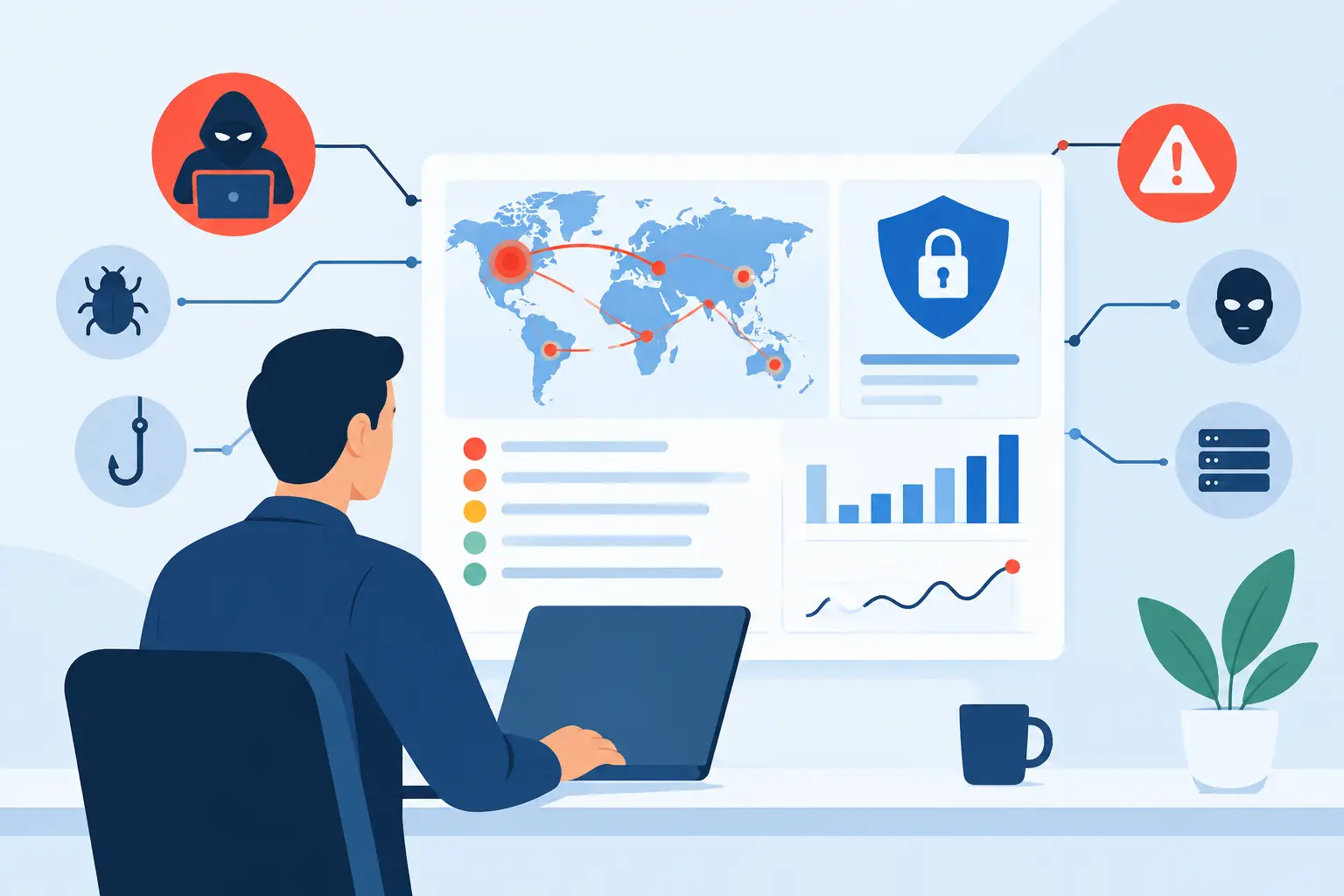
A threat report fails when it gives a decision-maker a name, a screenshot, and no way to judge what any of it means. A guide to threat intelligence reporting should start with a harder standard: can another trained person understand the source, assess the confidence, reproduce the review, and make an appropriate next move?
For security, investigations, and property operations teams, reporting is not administrative cleanup after an incident. It is the control point between a raw signal and an action that could affect staff, residents, visitors, or an active case. A fast facial match signal from a CCTV frame may help prioritize a review. It is not, by itself, proof of identity, intent, or wrongdoing.
What threat intelligence reporting must accomplish
Operational reports need to make uncertainty visible without becoming vague. The goal is to turn disconnected inputs – incident notes, access records, CCTV imagery, public-source material, witness observations, and match signals – into a defensible record of what was observed, what was assessed, and what should happen next.
A useful report answers five questions in order. What happened? What information was collected? What does that information suggest? How reliable is each part of the assessment? What action is authorized or recommended now?
That order matters. When analysts jump from an image to a conclusion, the report becomes difficult to defend. When they keep the observation separate from the assessment, supervisors can review the logic, challenge assumptions, and escalate only when the evidence supports it.
Threat intelligence reporting also needs an audience. A property manager deciding whether to increase patrols needs a concise operational recommendation. Corporate security may need a broader pattern assessment across locations. Counsel, law enforcement, or a client may need preservation details and a clear chain of review. One incident can produce more than one version, but every version should trace back to the same verified case record.
Start with the decision, not the data
Before collecting more material, define the question the report must answer. “Identify the person” is often too broad and may not be achievable from the available image. A better question might be: “Does this individual appear connected to prior trespass incidents at this property?” Or: “Does the available information justify a site-level safety precaution or law enforcement handoff?”
This framing prevents indiscriminate searching and keeps the investigation in the public-interest lane. It also makes the scope clear for reviewers. If the question concerns a possible repeat trespasser, the report should not drift into unrelated personal details that do not affect the safety decision.
Record the incident time, location, reporting party, case owner, and immediate safety concern before running searches. Preserve the original CCTV frame or uploaded image, along with relevant context such as camera location, clip time range, and whether the image was cropped, enhanced, or extracted from video. An image without provenance is a weak foundation for an escalation.
Build the record around facts, signals, and assessments
The clearest reports separate three layers of information. Facts are directly observed or documented: a person entered a restricted door at 10:42 p.m.; a camera captured a face at a stated location; a witness reported a vehicle leaving the area. Signals are investigative leads, such as a visual similarity result, a public post, or a recurring alias. Assessments explain what the available facts and signals may mean.
This distinction is especially important when facial matching is involved. A confidence-scored visual result can direct an investigator to review a possible source, but the score is not an identity determination. Report it as a lead: “The submitted frame returned a potential visual similarity signal associated with publicly available material. An analyst reviewed the source context; independent confirmation remains pending.”
Avoid statements such as “the system identified the suspect” unless identity has been established through validated, independent evidence and the statement is authorized for the report’s purpose. A more accurate report describes the method, the result, the review performed, and the limits that remain.
Use confidence language that drives action
Confidence should describe both the source quality and the strength of the inference. A crisp CCTV image tied to a controlled camera and timestamp has stronger provenance than a forwarded screenshot with no known origin. A source page that shows relevant timing and context is more useful than a profile image with no connection to the incident.
Instead of assigning confidence as a decorative label, connect it to an operational threshold. A low-confidence lead may justify preserving footage or monitoring a known access point. A moderate-confidence pattern may justify a supervisor review, additional camera checks, or a request for corroboration. A high-confidence, independently corroborated assessment may support a formal incident handoff under the organization’s policy.
The report should state what would increase or reduce confidence. For example, an additional camera angle, badge-access event, verified vehicle information, or direct witness confirmation could strengthen an assessment. Contradictory timestamps, poor image quality, or a source with unclear provenance should reduce it.
A practical reporting workflow
Start with a short incident narrative written in plain language. Describe the behavior and circumstances before describing any search result. That preserves the original reason for review and protects against confirmation bias.
Next, create an evidence log. For each item, capture where it came from, when it was collected, who collected it, what it shows, and whether the original was preserved. Screenshots may be useful for quick review, but retain the original file where policy permits. If a source is publicly available, preserve the relevant source reference and access date so another reviewer can understand the context that was available at the time.
Then document the analytical steps. Note the submitted image, any material edits made for clarity, the search date, the returned similarity signal, and the human review performed. Human-in-the-loop review is not a slogan. It means a trained person checks whether the image quality, surrounding context, time frame, and corroborating facts actually support the proposed connection.
Finally, write the recommended action as a proportionate next step. “Increase evening patrol visibility near the west entrance for seven days” is more useful than “remain vigilant.” “Refer the preserved materials to the corporate security lead for review” is more defensible than directing an outcome the evidence cannot support.
SafetyCamAI supports this workflow by helping professional teams turn submitted photos and CCTV frames into confidence-scored match signals, retain source context, and package evidence for review. The operating principle remains the same: use the platform to triage and verify, not to replace judgment.
Include the details reviewers need
A report should stand on its own when the original analyst is unavailable. At minimum, the case record needs the incident identifier, dates and times, location, involved assets or camera references, image provenance, source references, findings, confidence rationale, reviewer identity, and recommended disposition.
For serious incidents, record who approved each escalation and when. This is not bureaucracy for its own sake. It creates accountability when a case later reaches a client, insurer, counsel, or law enforcement partner. It also helps teams identify recurring gaps, such as cameras with poor night coverage or repeated reports that lack usable time stamps.
Keep sensitive details limited to the people who need them. A report intended for a property team may not need the same source detail as an internal investigative file. Use role-based access, follow retention schedules, and avoid copying personal information into broader distribution channels simply because it appeared in a lead.
Compliance boundaries protect the investigation
Threat intelligence reporting is strongest when it is tied to a legitimate security purpose, a defined scope, and a documented review process. Teams should know which sources they may use, what internal approvals apply, how long material may be retained, and when a matter must be transferred to an authorized party.
Do not treat visual similarity, public-source content, or an analyst’s impression as a basis for employment, housing, credit, insurance, or other consumer eligibility decisions. Safety-focused intelligence tools are not consumer reporting agencies, and professional teams should not use them as substitutes for legally required screening processes.
Be equally careful with language. Describe conduct and evidence, not stereotypes or assumptions about protected characteristics. State when a person’s identity is unknown. State when a connection is unverified. Precision protects subjects, investigators, and the organization making the decision.
Make reports useful after the incident closes
The best reports improve the next response. After disposition, ask whether the evidence was sufficient, whether escalation was proportionate, and whether the report made the decision easier or harder. A brief after-action note can reveal patterns that incident narratives alone miss: repeat access points, recurring hours, gaps in camera placement, or frequent delays in preserving footage.
That feedback loop turns reporting into a working security capability. When the next uncertain image or suspicious activity report arrives, your team should not be starting from instinct. It should be working from a disciplined record of what was observed, what was verified, and what action the evidence truly supported.