

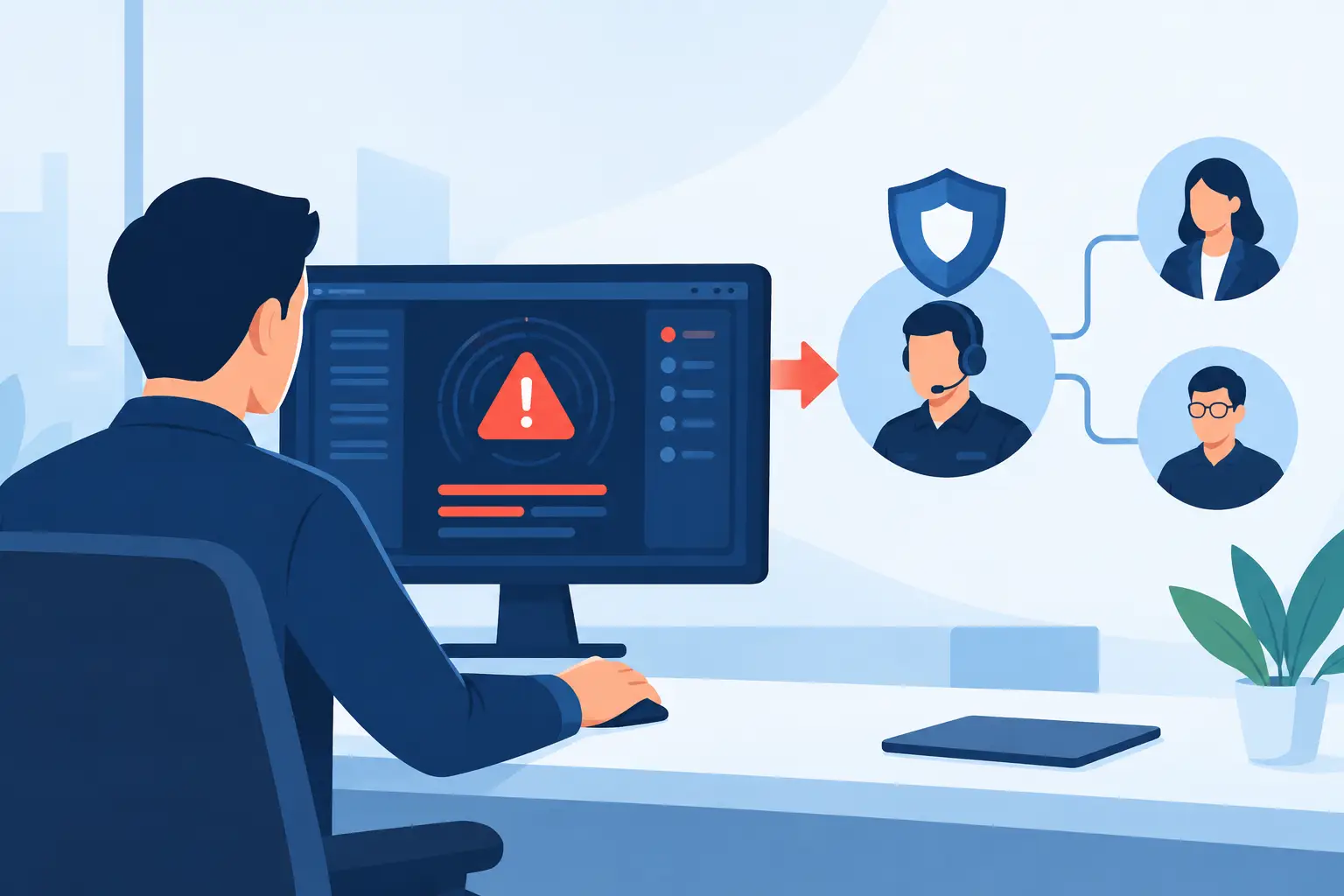
A person appears repeatedly near a restricted door. A resident reports being followed in a parking garage. A CCTV frame may resemble someone connected to a prior incident. The operational question is not simply whether the event feels suspicious. It is when should security escalate based on facts that can be reviewed, documented, and acted on without overreaching.
For security teams, investigators, and property operators, escalation is a decision point. It changes who is notified, what access is restricted, how evidence is preserved, and whether law enforcement or emergency services become involved. Get there too slowly and a preventable risk can grow. Get there on weak information and the organization can create unnecessary harm, liability, and loss of trust.
When Should Security Escalate? Start With Risk, Not a Hunch
Security should escalate when the available facts indicate a credible and proportionate risk to people, property, operations, or an active investigation. A hunch can justify closer observation. It should not, by itself, justify an accusation, detention, tenant action, or external report.
The difference is context. One person lingering near a loading dock may be waiting for a ride. The same person trying multiple locked entrances, watching staff badge patterns, and returning after being asked to leave is a different risk picture. Escalation should reflect the behavior, the location, the timing, and any corroborating evidence.
A practical threshold is this: escalate when a reasonable reviewer can understand what happened, why it matters, and what immediate action is necessary from the record alone. That record may include video clips, still frames, access-control logs, incident reports, witness observations, and verified public-source information. It should distinguish confirmed facts from assumptions.
Use an Escalation Ladder Instead of a Single Trigger
Not every concern belongs in the same channel. Teams need an escalation ladder that gives staff a clear next move while preserving room for human judgment.
Level 1: Document and Monitor
Use this level when conduct is unusual but does not show an immediate threat. Examples include repeated presence in a common area, an unknown individual photographing a building exterior, or a vehicle circling a property without approaching it.
Capture the date, time, location, description, relevant video, and the specific behavior observed. Avoid labels such as “dangerous” or “suspicious person” unless the report explains exactly what supports that description. Notify the appropriate supervisor if the pattern continues or the subject enters a sensitive area.
Level 2: Verify and Coordinate
Move to verification when there is a policy concern, a recurring pattern, a potential connection to an earlier incident, or a credible report that needs context. This may mean checking access records, comparing time-stamped CCTV footage, speaking with a witness, or reviewing permitted public-source signals.
An image match or face-search result belongs at this level as a lead, not a final answer. Confidence scoring can help prioritize review, but a match signal does not establish identity, intent, or wrongdoing. A trained reviewer should compare the source image quality, facial features, date and location context, and any conflicts in the available information before the team acts.
SafetyCamAI supports this verification-first workflow by helping teams organize confidence-scored image signals, source context, and exportable evidence. The operational value is speed with an audit trail, not automated decision-making.
Level 3: Protect the Site and Notify Leadership
Escalate to site protection when behavior suggests a near-term operational or safety concern. That can include attempted forced entry, threats toward staff or residents, unauthorized access to controlled areas, credible stalking behavior, tampering with cameras, or activity consistent with planning theft or violence.
Actions may include increased patrols, a temporary access restriction, supervisor notification, a welfare check through established channels, or coordination with building management. The response should be proportional. Restricting access to a secured room based on documented attempted entry may be reasonable. Banning a person from an entire property based on an unverified image resemblance usually is not.
Level 4: Emergency or Law Enforcement Escalation
Call emergency services when there is an immediate threat to life, serious injury, active violence, a weapon-related threat, fire, or an unfolding crime requiring urgent response. Do not delay a 911 call while trying to improve an image match or complete an internal report.
Law enforcement notification may also be appropriate for credible threats, significant property crimes, restraining-order concerns, missing-person matters, or a documented pattern that meets the organization’s reporting criteria. Share factual observations and preserved evidence. Do not present a probabilistic match as a confirmed identification.
What Makes an Escalation Defensible
A defensible escalation can withstand review by a supervisor, client, attorney, law enforcement partner, or the person responsible for compliance. It does not depend on a single dramatic claim. It shows how the team moved from observation to action.
Start with provenance. Where did the information come from? Preserve original CCTV files where possible, note who exported them, retain timestamps, and record whether a still frame was enhanced, cropped, or extracted from video. If a witness provided information, record what they saw directly rather than rewriting it as a conclusion.
Then document corroboration. Did access logs show an attempted entry at the same time? Did two independent witnesses report the same conduct? Did the person appear across multiple cameras or dates? Corroboration does not require certainty, but it helps teams separate a real pattern from an isolated and ambiguous event.
Finally, document the decision itself. State the risk assessed, the action taken, who authorized it, and what follow-up is required. This matters when a shift change occurs or when an incident later becomes part of an investigation. It also prevents quiet escalation based on rumor, bias, or incomplete handoffs.
Image Signals Require a Human-in-the-Loop Decision
CCTV footage is often imperfect. Low light, motion blur, oblique angles, compression artifacts, masks, hats, and lookalikes all affect reliability. A face image that produces a possible public-source match may help an investigator identify leads, but it cannot carry an escalation alone.
Before using an image-based signal in an incident response, ask three questions. Is the source image sufficiently clear to support comparison? Does the associated source context actually fit the date, place, and circumstances? What other evidence connects this person to the event?
If those answers remain uncertain, keep the finding in the investigative lane. Continue monitoring, seek better footage, compare additional frames, or obtain a supervisor’s review. Do not use an unverified result to make employment, housing, credit, insurance, or other consumer eligibility decisions. Professional security work requires purpose limitation and lawful handling of information.
Escalate Behavior, Not Protected Characteristics
Good escalation policy focuses on observable conduct and site-specific risk. It does not treat race, ethnicity, religion, disability, gender identity, housing status, or a person’s general appearance as a threat indicator. Nor should a team escalate because someone resembles a person in an outdated or context-free image.
This is not only a compliance issue. It makes investigations better. Behavior-based reporting produces clearer evidence, more consistent decisions, and fewer false positives. Instead of writing that someone “looked out of place,” document that they attempted to follow an employee through a secure door at 10:14 p.m., then moved out of camera view after being challenged.
Build the Decision Before the Incident Happens
The hardest time to decide who can authorize escalation is during a fast-moving event. Every site should define its triggers, owners, and notification paths in advance. A property manager may own tenant communication. A security supervisor may own site lockdown decisions. Corporate risk may own external reporting for a major incident.
Keep the policy usable. Staff should know what requires immediate emergency action, what requires a supervisor call, and what should be logged for review. Training should include realistic gray-area scenarios, because most events are not as clear as an active break-in.
Escalation is not a sign that a team has failed to prevent risk. Done correctly, it is a disciplined handoff: facts are preserved, uncertainty is stated, the right decision-maker is engaged, and the response matches the threat. That is how security teams protect people while keeping their actions fair, lawful, and defensible.