

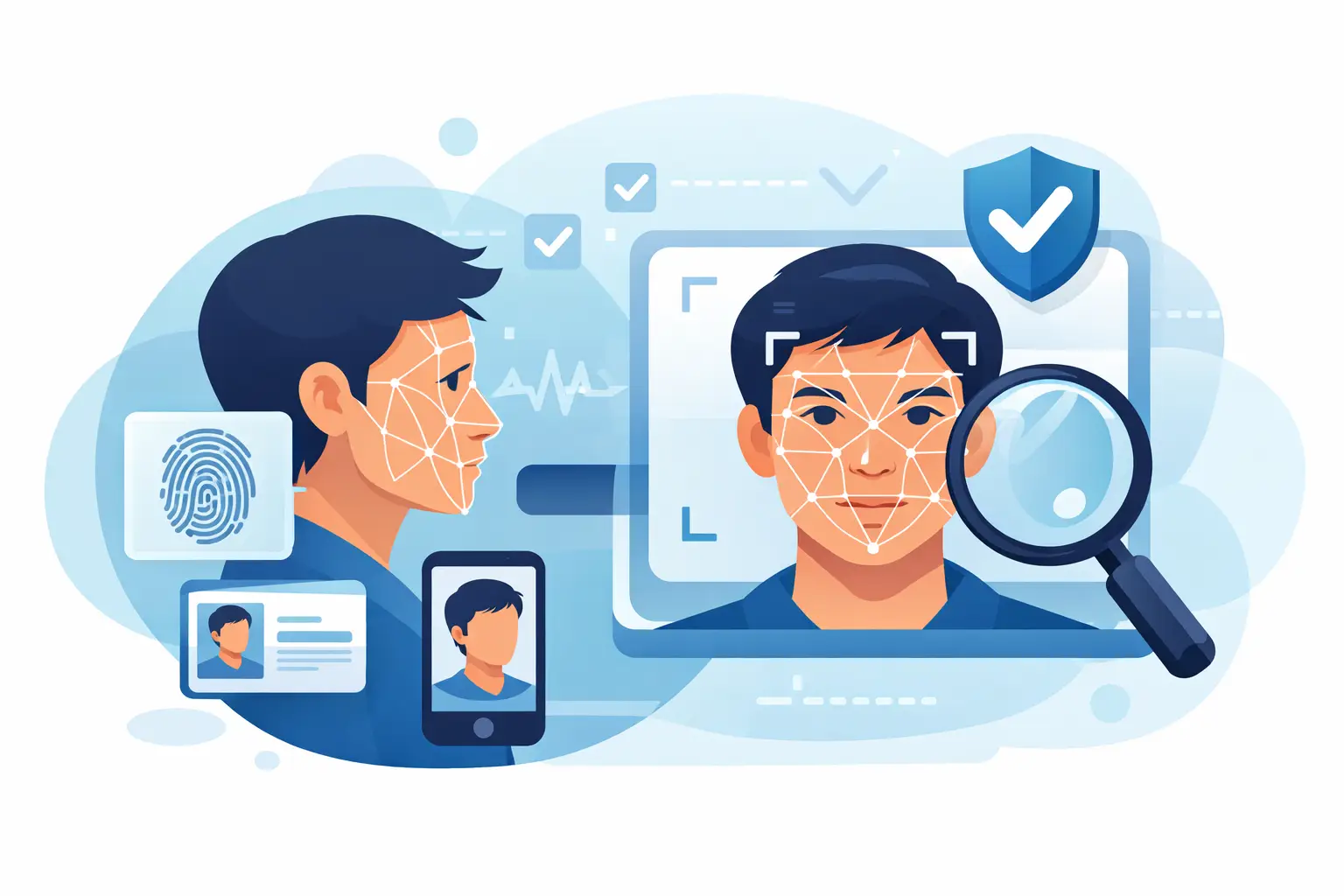
A face match is not the decision. It is the signal that tells you whether a case needs review, escalation, or closure.
That distinction matters when you are figuring out how to validate face match evidence in a security or investigative workflow. A match result can move an incident forward fast, but if the image is weak, the source is misleading, or the context is wrong, speed turns into liability. For property teams, investigators, and security operators, the job is not just to find a likely match. The job is to determine whether that match can stand up to internal scrutiny and lawful use.
What validation actually means
Validation is the process of testing whether a face match is reliable enough to support the next operational step. In practice, that means checking the input image, reviewing match quality, confirming the source, comparing identifying features, and documenting what was reviewed.
This is where many teams make avoidable mistakes. They treat a confidence score like proof, or they stop at visual similarity without confirming where the image came from and whether the context lines up. In a compliance-conscious workflow, neither is enough. Human review stays in the loop because software can rank candidates, but it cannot carry responsibility for the final judgment.
Start with the image before you trust the result
The fastest way to weaken a match is to begin with a poor probe image. CCTV frames, mobile screenshots, and cropped social images often introduce blur, compression, angle distortion, and bad lighting. If the input is compromised, the output needs more skepticism, not less.
Look at the face itself first. Are the eyes visible? Is the nose bridge clear? Can you see the jawline, ears, or hairline without obstruction? Heavy shadow, motion blur, sunglasses, masks, side profiles, and extreme head tilt all reduce reliability. A low-resolution face can still return candidates, but that does not mean those candidates are fit for action.
If you have multiple frames, do not validate from a single still unless you have no other option. Pull several images from the same sequence and compare how stable the candidate match remains across them. A candidate that only appears convincing in one frame but falls apart in adjacent frames is weak evidence.
How to validate face match evidence with confidence scores
Confidence scores are useful, but only when they are treated as ranking signals rather than findings of fact. A higher score may indicate that a candidate deserves attention first. It does not mean the identity is confirmed.
The right question is not, “Is this score high enough?” The right question is, “Does this score stay consistent with what the images and sources show?” If the face geometry appears close, the source image is recent and attributable, and multiple frames point to the same person, the score becomes more meaningful. If the score is high but the source is old, heavily filtered, or visually inconsistent on key features, the number should carry less weight.
Thresholds also depend on use case. For incident triage, a lower-confidence result might justify additional review. For escalation to authorized professionals, trespass action, or internal disciplinary implications, the standard should be much higher and tied to corroboration. That is the trade-off. Lower thresholds increase speed and lead volume. Higher thresholds reduce false positives but may leave some real leads unflagged.
Review the source, not just the face
A face match without source review is unfinished work. You need to know where the image appeared, when it appeared, and whether the surrounding context supports the candidate identity.
Start with attribution. Is the source tied to a real profile, publication, event page, or other public-facing context? Or is it a repost, meme account, anonymous aggregation page, or recycled image with no stable ownership? Source quality matters because a visually similar face on a weak source is much less defensible than a similar face on a source that clearly connects the person to a name, place, or activity.
Then check recency. Faces change over time through age, weight change, facial hair, hairstyle, and image editing. An old image may still be relevant, but it should not be treated the same as a recent one. If the source image is five years old and your incident frame is current, your review should account for that gap.
Finally, evaluate context. If the candidate source places the person in the same city, venue type, social circle, or event pattern relevant to the case, that strengthens the lead. If the source context is disconnected from the incident, the match may remain only a possibility, not a validated conclusion.
Compare fixed features before variable ones
When reviewing a candidate, some traits carry more value than others. Hair style, facial hair, makeup, and accessories change quickly. Bone structure changes less.
Prioritize fixed features such as eye spacing, nose shape, brow structure, ear shape, chin line, and overall facial proportions. Then use variable features as secondary support. A hat can come off. A beard can disappear. The distance between the eyes and the shape of the nostrils are harder to fake across multiple images.
Do not rely on one striking similarity. Many false positives happen because reviewers anchor on a single feature such as a smile, tattoo placement near the face, or hairline. Validation requires feature agreement across the face, not one memorable coincidence.
Use corroboration when the stakes are high
The higher the consequence, the more face evidence should be treated as one layer, not the whole case.
Corroboration can include timestamps, location overlap, clothing continuity across camera views, vehicle association, witness statements, access control logs, or related public-source images from the same timeframe. None of those items alone proves identity either, but together they can move a case from plausible to operationally defensible.
This matters most when the result may trigger removal from property, fraud review, workplace action, or authorized professionals handoff. In those situations, a face match should support a broader evidentiary picture rather than carry the full burden by itself.
Build a human review standard your team can repeat
If different analysts would reach different conclusions from the same match, your process is too loose. Validation needs repeatable standards.
A practical review standard usually includes four checks. First, the input image must be usable enough for comparison. Second, the candidate source must be attributable and relevant. Third, the face comparison must show agreement on multiple fixed features. Fourth, the reviewer must record why the match was accepted, rejected, or held for more evidence.
This is also where a human-in-the-loop platform earns its place. The value is not just search speed. It is the ability to review candidate matches, inspect source links, compare frames, and package findings in a way that another person can audit later. SafetyCamAI is built around that verification-first lane, which is the right fit for teams that need actionable signals without pretending an algorithm made the final call.
Document your reasoning like someone else will review it
Someone probably will. That might be a supervisor, legal team, client, insurance partner, or authorized professionals contact. If your file only says “possible match,” it is not enough.
Your record should note which images were used, what candidate sources were reviewed, what features were compared, how strong the agreement appeared, and what limitations were present. If the image quality was poor, say so. If the source looked credible but the age gap was significant, say that too. Good documentation does not weaken your case. It shows discipline.
This is especially important for teams operating in a public-interest lane rather than a consumer-reporting lane. You are not issuing background reports. You are validating whether a lead is credible enough for a lawful operational response. The paperwork should reflect that boundary.
Common validation mistakes that create risk
The most common failure is treating a match result like identity proof. Close behind that is ignoring source quality and relying on screenshots with no traceable origin. Another frequent mistake is overconfidence with low-quality CCTV frames, especially when the reviewer wants a fast answer and starts seeing confirmation instead of evidence.
There is also the problem of context collapse. A reviewer finds a visually similar face and then assumes the person belongs in the incident because the match feels plausible. That is backward. Validation means testing the theory, not decorating it.
If a result is uncertain, mark it uncertain. A disciplined hold is better than a reckless escalation.
What good validation looks like in practice
Good validation is fast, but not casual. It uses the best available image, reviews multiple candidates, checks source credibility, compares fixed features, looks for corroboration, and records the limits of the finding.
Sometimes that process ends with a strong lead worth escalating. Sometimes it ends with a likely exclusion. Sometimes it ends with “not enough to act.” All three outcomes are useful. The goal is not to force certainty. The goal is to reduce error while keeping your workflow moving.
If you are building a repeatable process around how to validate face match evidence, keep one rule at the center: the match opens the door, but validation decides whether you walk through it.
Responsible Use & Disclaimer: SafetyCamAI is a reverse-image / visual similarity search tool. It finds visually similar images from publicly accessible sources for informational purposes only. It does not identify individuals, verify identities, confirm criminal history, or provide arrest or background-check information. Results must not be used for employment, housing, credit, or any FCRA-covered purpose. Always use the app lawfully and ethically.