

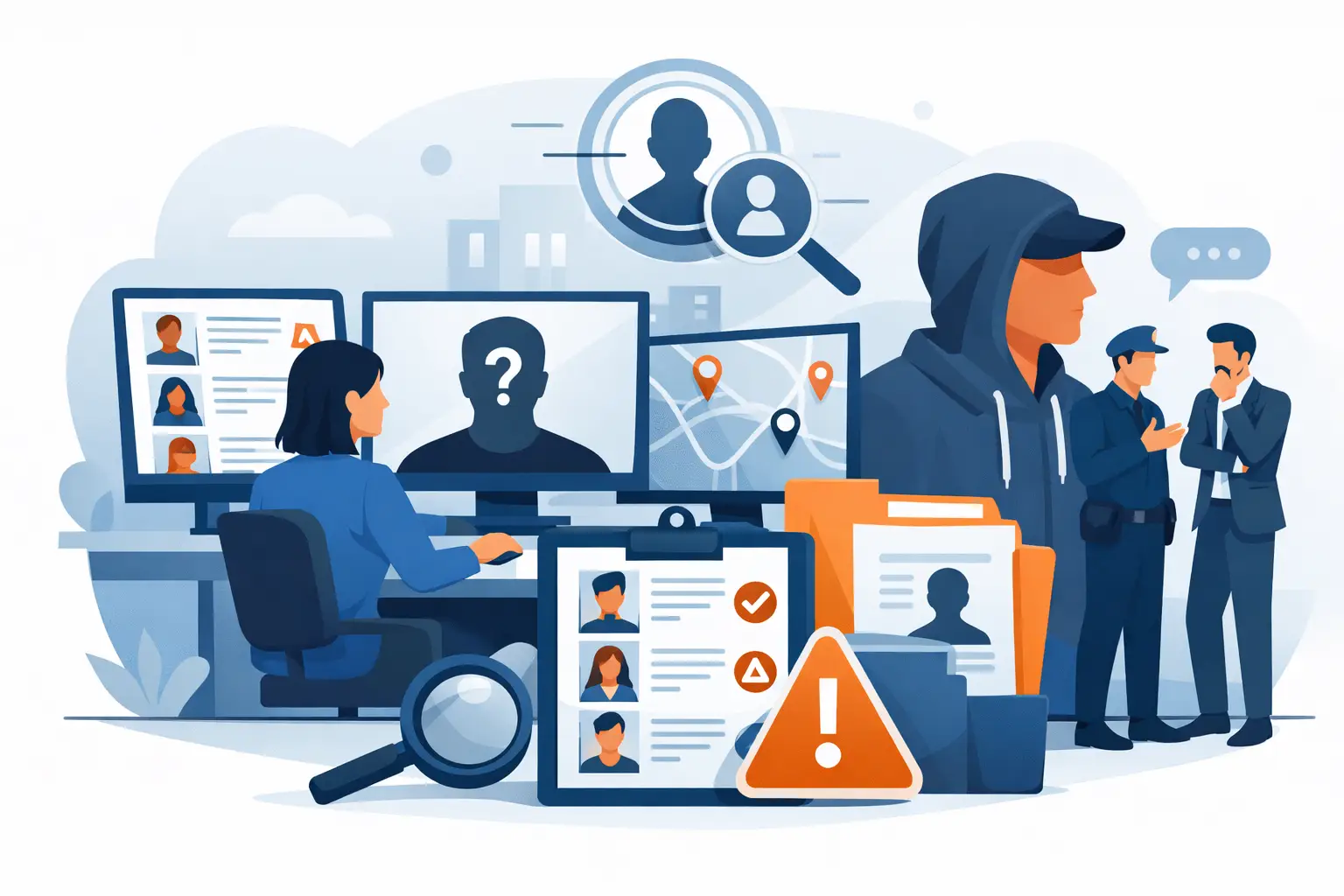
A resident calls the front desk and says, “There’s a guy walking the garage again.” A retail manager forwards a blurry still from CCTV. A guard notes someone lingering near a loading dock but can’t tell whether it was routine, random, or pre-operational behavior. These are the moments when knowing how to triage suspicious person reports matters. The goal is not to guess faster. It is to move from vague concern to defensible action.
Poor triage creates two problems at once. If you overreact, you burn time, strain staff, and risk turning ordinary behavior into a documented incident that never should have escalated. If you underreact, you miss the early indicators that separate nuisance activity from a real threat. The right process sits in the middle – fast, structured, and human in the loop.
What good suspicious person triage actually does
A strong triage process answers three questions before anything else. First, what exactly was observed? Second, what makes the behavior suspicious in context? Third, what action is justified right now based on facts, not assumptions?
That context piece is where teams often fail. A person standing near an entrance at 2:00 p.m. may be waiting for a ride. The same behavior at 2:00 a.m., combined with repeated passes by access points or attempts to avoid cameras, is different. Suspicion is not a category of person. It is a category of behavior, setting, timing, and pattern.
That distinction also matters for compliance. Professional security and investigation teams need disciplined documentation and lawful use standards. You are not making consumer-reporting decisions. You are reviewing a safety signal, validating what you can, and deciding whether to monitor, document, or escalate.
How to triage suspicious person reports without overcalling them
Start with the report itself. Most incoming reports are incomplete, emotional, or both. That does not make them useless. It means they need structure. Pull out the specifics: exact location, date and time, direction of travel, reported behavior, duration, and any interaction with people, property, or access points.
Then separate observation from interpretation. “Male in dark hoodie walked past Building C three times and looked into parked cars” is useful. “Casing the property” may eventually be true, but it is still an interpretation. Your incident record should preserve the observed facts first and label any assessment as preliminary.
Next, look for immediate risk indicators. If there is active trespass into a restricted area, attempted forced entry, weapon visibility, direct threats, stalking behavior, interference with staff, or signs of imminent harm, this is no longer just triage. It is an active escalation event. Your workflow should reflect that distinction clearly.
If there is no immediate threat, move into verification. Review available CCTV. Pull the clearest frame showing face, clothing, distinguishing features, companions, vehicle association, and travel path. Compare the report to footage rather than letting the report shape what you think you saw. Memory fills gaps. Video narrows them.
Build a risk-based review standard
Not every suspicious person report deserves the same effort. A practical system uses levels. You do not need a complicated scoring model, but you do need thresholds.
A low-level report usually involves unusual presence without a clear prohibited act – loitering, repeated pass-throughs, or behavior that drew attention but lacked a threat indicator. In these cases, the right action may be documentation, limited monitoring, and checking whether the person appears in prior incident logs.
A medium-level report generally adds pattern, proximity, or targeting. That could mean repeated appearances across dates, movement focused on vulnerable areas, attempts to test access, or conduct that aligns with prior theft or intrusion patterns on site. These cases justify deeper verification and supervisor review.
A high-level report includes immediate danger, targeted pursuit, active entry attempts, visible tools or weapons, or direct connection to a recent crime or banned individual alert. These cases require fast escalation under your site protocol, with documentation happening alongside response.
The trade-off is simple. If your thresholds are too low, your teams spend the day chasing noise. If they are too high, you lose the chance to intervene early. The best standard is one that can be explained later in a report, to management, or to authorized professionals if needed.
Use images to verify, not to speculate
When footage is available, image-led verification can shorten triage dramatically. A clear face frame or still from CCTV gives your team something more reliable than secondhand description. It can help determine whether the person has appeared before, whether online public-source context exists, or whether the same subject is tied to multiple incidents.
This is where discipline matters. A face match signal is not the final answer. It is a lead. Confidence scores, source review, image quality, and corroborating details all matter. Human review stays in the loop because operational decisions require validation, not automation alone.
For professional users, tools such as SafetyCamAI fit this verification-first lane because they are built around photo and CCTV workflows, confidence-scored results, and exportable evidence packaging rather than broad consumer profiling. That matters when your real need is to assess a report quickly, preserve what you found, and escalate appropriately within compliance guardrails.
Still, there are limits. Low-resolution night footage, partial profiles, hats, masks, and backlighting can reduce reliability. Teams should avoid forcing a match where the image does not support one. “No actionable match” is a valid triage outcome.
What to document during suspicious person triage
Good documentation protects the case and the team. It should be detailed enough to support escalation, but clean enough that another reviewer can follow it without guessing what happened.
Record who made the report, when it was made, and whether the source personally observed the behavior or heard it secondhand. Note the exact behavior described, the location, camera references, timestamps, and any associated vehicle or companion details. Preserve the best stills and clips. If you ran verification steps, document what sources were checked, what signals were returned, the confidence level, and what was or was not corroborated.
Just as important, document the action taken. Was the subject monitored only? Was patrol redirected? Was access control reviewed? Was management notified? Was authorized professionals contacted? A triage record without a disposition is incomplete.
Keep the language factual and restrained. Avoid labels that suggest criminality unless you have evidence to support them. “Observed attempting door handles on west entrance” is stronger than “likely burglar.” One is defensible. The other creates exposure if the facts do not hold up.
When to escalate and when to hold
The hardest part of how to triage suspicious person reports is deciding when enough is enough. In practice, escalation should follow a combination of present risk and verified context.
Escalate quickly when behavior shows threat, targeting, or criminal intent that is immediate or strongly supported. Escalate more carefully when the concern is pattern-based but not urgent. In those cases, a supervisor review, internal bulletin, or watchlist-style monitoring may be more appropriate than a full external referral.
There are also times to hold. If the report is vague, footage is inconclusive, and no policy violation or threat indicator is present, forcing escalation can do more harm than good. Document the event, preserve the evidence, and set a trigger for reopening if the person reappears or new facts emerge.
That restraint is not inaction. It is disciplined triage.
The operational mistakes that create bad outcomes
The most common mistake is treating all suspicious person reports as equal. They are not. A complaint based on discomfort alone should not receive the same response as observed access testing near a restricted area.
The second mistake is letting urgency wipe out review. Speed matters, but unsupported assumptions travel fast inside organizations. Once a speculative label enters an incident chain, it can shape every later decision.
The third is weak evidence handling. If stills are not preserved, timestamps are missing, or your team cannot explain why it escalated one case and not another, the process breaks down under scrutiny.
And the fourth is forgetting the legal lane. Verification tools are there to support safety, investigations, and lawful escalation. They are not a shortcut to identity claims without corroboration, and they are not a replacement for policy, training, or judgment.
A better standard for front-line teams
The teams that handle suspicious person reports well do not rely on instinct alone. They use a repeatable workflow: capture the facts, assess immediate risk, verify with available footage and public-interest signals, document cleanly, and escalate only when the evidence supports it.
That standard helps everyone involved. Guards make fewer judgment calls in a vacuum. Property teams get cleaner incident records. Investigators inherit stronger starting points. And when a report does turn into a real event, the groundwork is already in place.
The useful question is not “Was this person suspicious?” It is “What did we observe, what did we verify, and what action was justified at that moment?” Ask that every time, and your triage process gets faster, sharper, and easier to defend.
Responsible Use & Disclaimer: SafetyCamAI is a reverse-image / visual similarity search tool. It finds visually similar images from publicly accessible sources for informational purposes only. It does not identify individuals, verify identities, confirm criminal history, or provide arrest or background-check information. Results must not be used for employment, housing, credit, or any FCRA-covered purpose. Always use the app lawfully and ethically.