

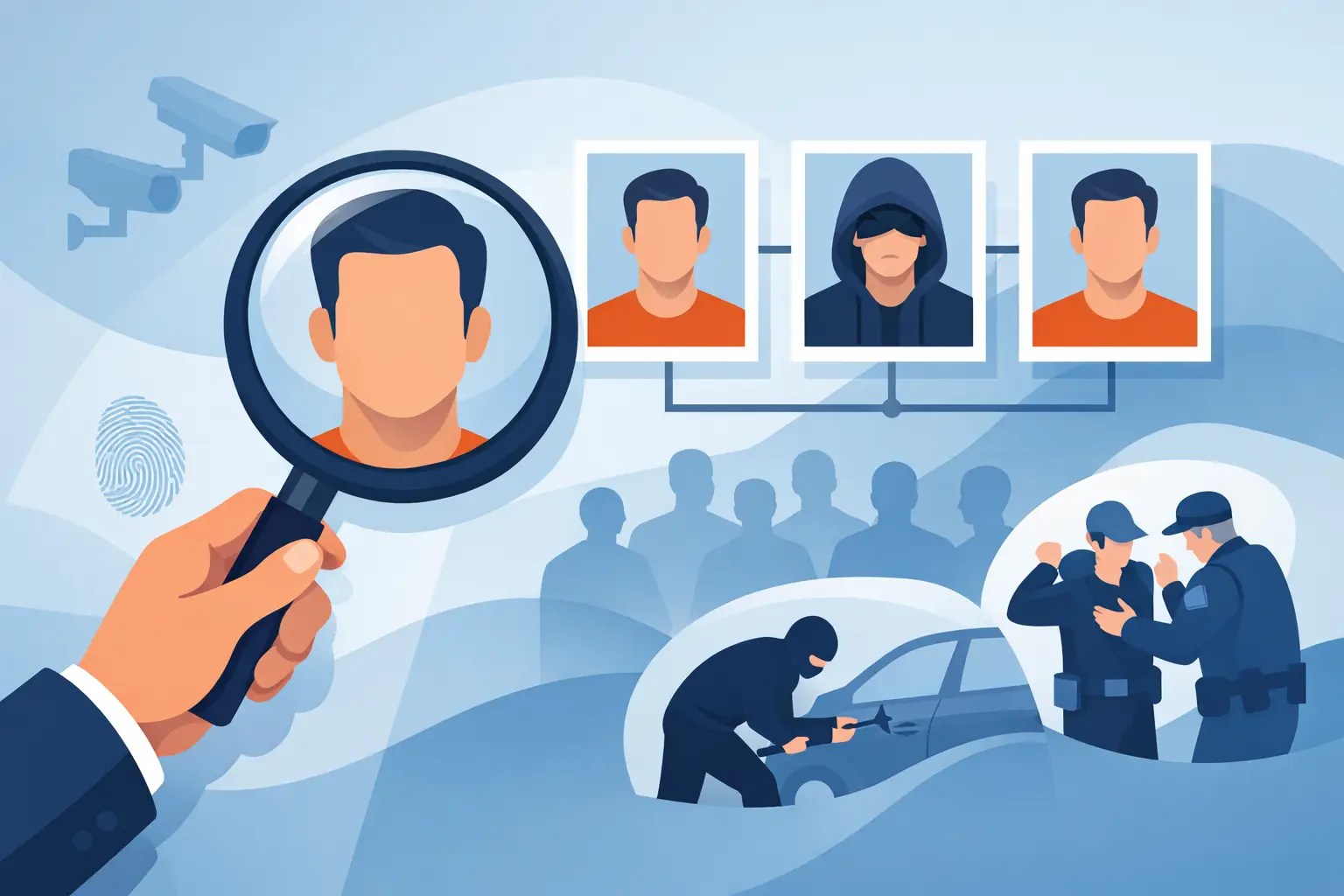
A property manager pulls a usable face frame from a garage theft incident. Two weeks later, security captures a similar-looking person testing door handles at another site. The operational question is immediate: can photos identify repeat offenders well enough to justify an escalation?
They can produce meaningful leads. They cannot, by themselves, prove identity, guilt, or a pattern of criminal conduct. For security and investigation teams, that distinction is where sound practice begins. A photo-based match should move a case from uncertainty to a structured verification process – not from suspicion to a final decision.
Can Photos Identify Repeat Offenders? Yes, With Verification
Photos can help identify possible repeat activity when there is enough usable visual information and a lawful basis to compare it. A clear face image from CCTV, an incident report photo, or an authorized image submission may reveal visual similarity across incidents or public sources. That similarity can be valuable for connecting cases, prioritizing review, and deciding whether to preserve footage or notify the appropriate party.
But facial similarity is not identity verification on its own. Camera angle, compression, motion blur, lighting, age, facial hair, masks, and look-alike risk can all affect a result. A match signal is strongest when it is paired with independent facts: comparable clothing or accessories, timing, location, method of entry, vehicle details, witness observations, or a verified source that supports the same identity.
The practical standard is simple: treat the photo as an investigative starting point. A responsible workflow asks whether the available evidence supports the next action, not whether an algorithm has delivered certainty.
What a Photo Match Can and Cannot Tell You
A high-confidence visual match can indicate that two images may show the same person. It may also surface public-source material that gives an investigator a lead to examine. This is useful when a team needs to assess whether separate incidents could be connected, identify recurring access-control concerns, or prepare a focused handoff for law enforcement or internal leadership.
It cannot establish that a person committed an offense. It also cannot reliably establish intent, legal status, current whereabouts, or a person’s connection to an incident without corroboration. An image that appears in a public source may be old, mislabeled, reposted without context, or associated with someone who shares similar features.
That is especially relevant when the label “repeat offender” enters the conversation. Internally, teams should use precise language such as “possible recurring subject,” “potential cross-incident match,” or “person of interest pending verification.” Precise language reduces the risk that an early lead becomes an unsupported allegation in a report, email, or tenant-facing communication.
Image Quality Determines the Value of the Lead
The quality of the original image often matters more than the sophistication of the search. A sharp, forward-facing face frame provides more usable signal than a wide shot from a distant camera. Yet operational footage is rarely ideal. Investigators frequently work with low light, partial profiles, sunglasses, hoodies, and footage captured at difficult angles.
Start by selecting the best available frame rather than uploading the entire clip or the first image at hand. Look for an unobstructed face, adequate pixel detail, natural proportions, and limited motion blur. If several frames are available, compare them. One may show the face more clearly; another may capture a distinctive jacket, tattoo, bag, or companion.
Avoid overediting. Basic cropping that centers the face can help review, but aggressive sharpening, AI-generated enhancement, or alteration of features can create artifacts and complicate evidentiary integrity. Preserve the original file and document any working copy used for analysis. If an image is later reviewed by a supervisor, client, insurer, or law enforcement agency, the team should be able to show what was captured and what was changed.
A Defensible Workflow: Upload, Match, Verify, Act
The most useful photo-identification process is designed for review rather than automation. SafetyCamAI follows this logic by providing confidence-scored match signals and source context for human evaluation, not a final identity verdict.
1. Establish a lawful operational purpose
Before a search begins, define why the image is being reviewed. Examples include investigating a documented trespass, reviewing a theft or vandalism incident, assessing a credible safety concern, or comparing incidents within a property portfolio. Access should be limited to authorized personnel with a legitimate role in the investigation.
This is not a workflow for curiosity, personal disputes, or broad monitoring of people who have not been connected to a legitimate safety matter. The strongest programs operate in a clear public-interest lane with documented policies, access controls, and retention practices.
2. Create an incident record before searching
Record the basics: incident date and time, location, reporting party, camera identifier, original file name, and a short factual description of what occurred. Keep observation separate from interpretation. “Subject attempted to pull vehicle door handles at 2:14 a.m.” is more useful and defensible than “known thief returned.”
This record gives the match process context. It also makes it easier to compare separate events without relying on memory or informal staff conversations.
3. Review match signals against independent evidence
When a search returns possible matches, assess the source, date, image quality, and visible consistency. Do facial features align across multiple images? Is there a meaningful connection to the incident location or pattern? Could the apparent match be explained by a common appearance, unrelated reposting, or an outdated image?
A confidence score helps prioritize what to inspect. It should not replace inspection. A lower-scoring result with strong contextual support may warrant further review, while a high-scoring result with weak or questionable context may not support action.
4. Escalate proportionately
The response should fit the verified risk. A possible match may justify preserving video, increasing patrol awareness, checking access logs, or combining reports from nearby sites. A stronger, corroborated pattern may justify a formal incident package and a law enforcement handoff.
Do not publish a name, circulate an image widely, or impose punitive restrictions based only on a photo match. Where a decision could affect housing, employment, credit, insurance, or another regulated outcome, seek appropriate legal and compliance review. A safety platform is not a consumer reporting agency, and visual search results are not consumer reports.
Why Evidence Packaging Matters
Repeat-incident cases often fail because the facts are scattered. A CCTV clip lives in one system, a staff email contains another detail, and a possible match is saved as an unsupported screenshot. By the time someone asks what happened, the chain of review is unclear.
A better case file preserves the original image, the selected review frame, the time and source of each result, relevant source references, analyst notes, confidence signals, and the corroborating facts that led to an escalation. It should also document what the evidence does not establish. That restraint protects the credibility of the findings.
For multi-site property operators, standardized evidence packaging can reveal genuine patterns without turning every incident into a claim of identity. A regional security lead may see that several properties reported similar conduct, comparable timing, and a potentially recurring subject. That is actionable intelligence, provided each link is clearly labeled by its level of confidence.
Common Errors That Create Risk
The biggest error is treating a likely match as a confirmed name. The next is allowing a search result to spread beyond the people who need it to perform their jobs. Both can amplify an unverified lead into reputational, privacy, and legal exposure.
Teams also create avoidable risk when they search poor-quality frames repeatedly, rely on a single source, retain images indefinitely, or fail to distinguish facts from analyst conclusions. Clear internal rules should cover who can search, what cases qualify, how results are reviewed, when images are deleted, and who approves external escalation.
Training matters as much as technology. Staff should understand that a tool can surface leads quickly, while human judgment must assess accuracy, relevance, fairness, and the appropriate next step.
The Right Question Is Whether the Evidence Supports Action
Photos can help teams recognize possible repeat offenders, connect incident reports, and move faster when a safety concern is developing. Their real value is not a shortcut to certainty. It is the ability to turn a difficult visual clue into a documented, reviewable lead.
When every match is checked against context, preserved with evidence, and escalated only at the level the facts support, photo-based identification becomes a disciplined safety capability rather than a source of avoidable risk.