

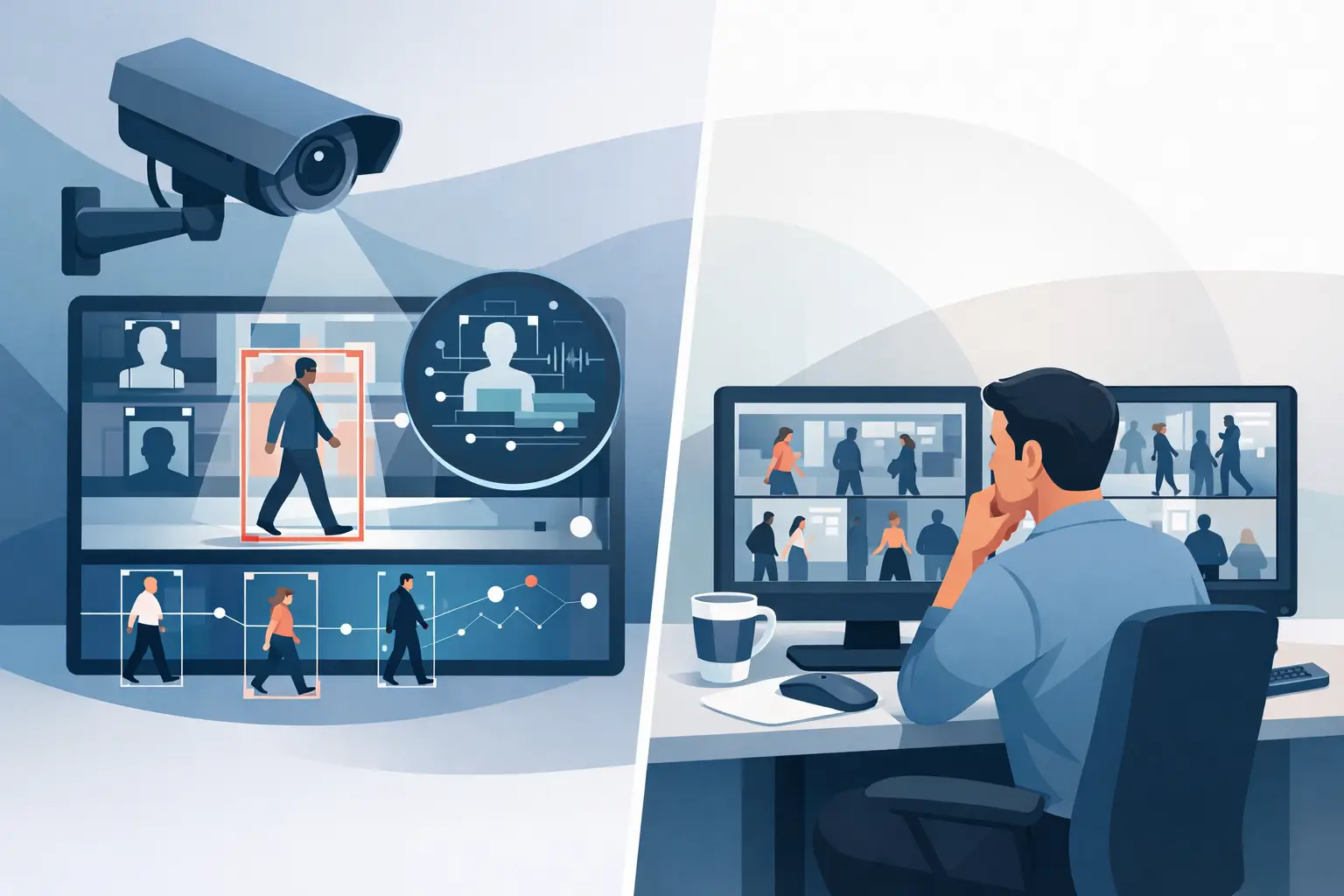
A tenant reports a trespasser at 2:13 a.m. The clip is grainy, the subject turns away from the camera twice, and your team needs to decide whether this is a routine nuisance or an escalation. That is where cctv frame analysis vs manual review stops being a theoretical debate and becomes an operational one.
For security teams, investigators, and property operators, the real question is not which method sounds better. It is which method gets you to a defensible next step faster, with less wasted effort and fewer bad assumptions. In most real incidents, the answer is not purely one or the other. It is knowing where automation helps, where human review is still essential, and how to keep the process compliant.
What CCTV frame analysis actually changes
Manual review has been the default for years because it is familiar. An analyst watches footage, pauses at useful moments, takes screenshots, compares clothing, movement, and facial visibility, and then writes up what they saw. That process can work, especially in smaller cases or when the incident window is narrow.
But CCTV frame analysis changes the unit of work. Instead of asking a person to inspect long stretches of footage line by line, it turns selected frames into searchable evidence. A usable face still, even from imperfect footage, can become a signal source for verification workflows. The gain is not just speed. It is that the reviewer is no longer limited to memory, patience, and repeated playback.
That matters when a team is under pressure. A retail security lead reviewing one incident might be fine with manual playback. A multi-site property group handling repeated trespass, package theft, and after-hours access concerns across several buildings is dealing with a different scale problem.
CCTV frame analysis vs manual review in real workflows
The cleanest way to compare cctv frame analysis vs manual review is by looking at how incidents actually move.
Manual review is strongest when context is the main challenge. If you need to understand what happened before and after an event, a human reviewer is better at spotting sequence, intent, and interaction. People notice that a subject loitered before approaching a door, that two individuals were coordinating, or that a person returned later in different clothing. Those judgments are difficult to reduce to a simple automated pass.
Frame analysis is strongest when identification or verification is the bottleneck. If you already know the incident time and camera angle, and the key task is pulling the clearest facial stills for comparison or follow-up review, software-assisted analysis can cut hours from the process. It can also reduce the common failure mode of missing the best frame because the reviewer is tired or rushed.
This is why the smartest teams do not treat the choice as binary. They use frame analysis to accelerate triage, then keep a human in the loop for validation, context review, and escalation decisions. That is the difference between operational speed and blind automation.
Speed is the obvious advantage, but not the only one
The first argument for frame analysis is time. Anyone who has worked an overnight incident queue knows how quickly footage review expands. A ten-minute event becomes an hour of review once you account for multiple angles, export steps, screenshots, note taking, and handoff.
AI-assisted frame workflows compress that front end. Instead of scrubbing everything repeatedly, the reviewer can identify key intervals, extract candidate frames, and move into verification faster. That is especially useful when the business question is immediate: do we escalate, trespass, notify, or monitor?
There is also a consistency benefit. Manual review quality varies by reviewer experience, fatigue, and case volume. Two people can watch the same clip and capture different stills. A frame-based workflow creates a more repeatable process, especially when paired with confidence-scored results and source-backed evidence packaging.
That said, speed can create its own risk. Faster signals are only helpful if the team treats them as signals. A confidence score is not a final determination. A facial match candidate is not a green light for punitive action. The value is in prioritizing what deserves human attention next.
Where manual review still wins
There is a reason experienced investigators do not hand off judgment to software. Footage is messy. Lighting shifts. Compression artifacts distort faces. Cameras mounted too high flatten key features. A person may be partially obscured by a hat, hoodie, mask, or motion blur.
Manual review remains essential when facial visibility is weak and the answer depends on contextual clues. Body language, gait, companions, entry behavior, and route through a property can matter as much as face visibility. In some cases, the face is simply not good enough for meaningful analysis, and forcing a match workflow wastes time.
Manual review also matters for lawful use. Teams need to ask whether the footage and resulting information fit a permitted purpose, whether escalation is justified, and whether the evidence package would hold up under internal scrutiny. Software can support that process, but it should not replace it.
For this reason, compliance-conscious teams tend to outperform both extremes. They do not rely on pure manual review when volume makes that impractical, and they do not rely on pure automation when legal defensibility matters.
Accuracy depends on the footage and the question
A lot of buyers ask which method is more accurate. The honest answer is that accuracy depends on what you are trying to determine.
If the question is, “Did this person enter through the west gate at 11:42 p.m.?” manual review may be more accurate because the task is event reconstruction. If the question is, “Can we generate useful face-based leads from these frames for verification?” frame analysis may outperform manual review because it is built for selection, comparison, and signal generation.
Bad footage narrows both methods. No system can create reliable identity conclusions from unusable imagery. Good teams understand the threshold between a weak lead and a defensible finding. They also document uncertainty clearly. That discipline is part of risk management.
A verification-first platform can help by surfacing confidence-scored results, source links, and exportable evidence without pretending to make the final call. That is the right model for professional use. It supports action while preserving reviewer responsibility.
Cost is not just software versus labor
Some teams look at cctv frame analysis vs manual review and reduce it to a budget question. That is too narrow.
Manual review looks cheaper until case volume rises. Labor costs compound quietly through overtime, delayed triage, missed patterns across sites, and slower escalation. A team that spends hours reviewing footage for low-yield incidents is not just spending money. It is losing response capacity.
Software-assisted frame analysis adds subscription cost, but it can lower operational drag when used correctly. The key phrase is used correctly. If the workflow is undisciplined, teams can end up exporting more noise, chasing weak signals, or creating documentation gaps.
The right comparison is not tool cost versus hourly wages. It is total case handling cost, including time to decision, evidence quality, reviewer consistency, and the ability to act before an issue repeats.
The best fit is usually a hybrid process
For most professional teams, the practical answer is straightforward. Use manual review to understand the incident. Use frame analysis to extract usable stills, generate leads, and support verification. Then return to human review before any meaningful action.
That hybrid model fits how real organizations work. Security staff need speed, but they also need audit-friendly outputs. Investigators need candidate signals, but they also need source review. Property managers need to know whether a repeat subject warrants escalation, but they also need clear boundaries around lawful use and documentation.
This is where a platform like SafetyCamAI fits naturally into the workflow. It is not designed as a consumer people-search shortcut. It is designed for professional teams working from photos and CCTV, with a human in the loop and compliance guardrails in place. That difference matters when the goal is not curiosity, but defensible safety action.
How to choose for your team
If your incidents are low volume and mostly require timeline reconstruction, manual review may still carry most of the load. If your team handles repeated unknown-person incidents, cross-site reviews, or urgent identity verification tasks, frame analysis likely deserves a central role.
The deciding factor is usually not technical capability. It is operational friction. Where does your team lose time? Where do cases stall? Where do reviewers disagree? Where does evidence packaging break down? Those are the pressure points that frame analysis can relieve.
The strongest teams treat footage review as a decision pipeline, not a viewing exercise. They extract the clearest frames, verify against permitted sources, document what the result does and does not support, and escalate appropriately. That is faster than manual review alone and safer than automation alone.
When the footage is messy and the stakes are real, the best workflow is the one that gets you to a justified next step without pretending certainty where none exists.